
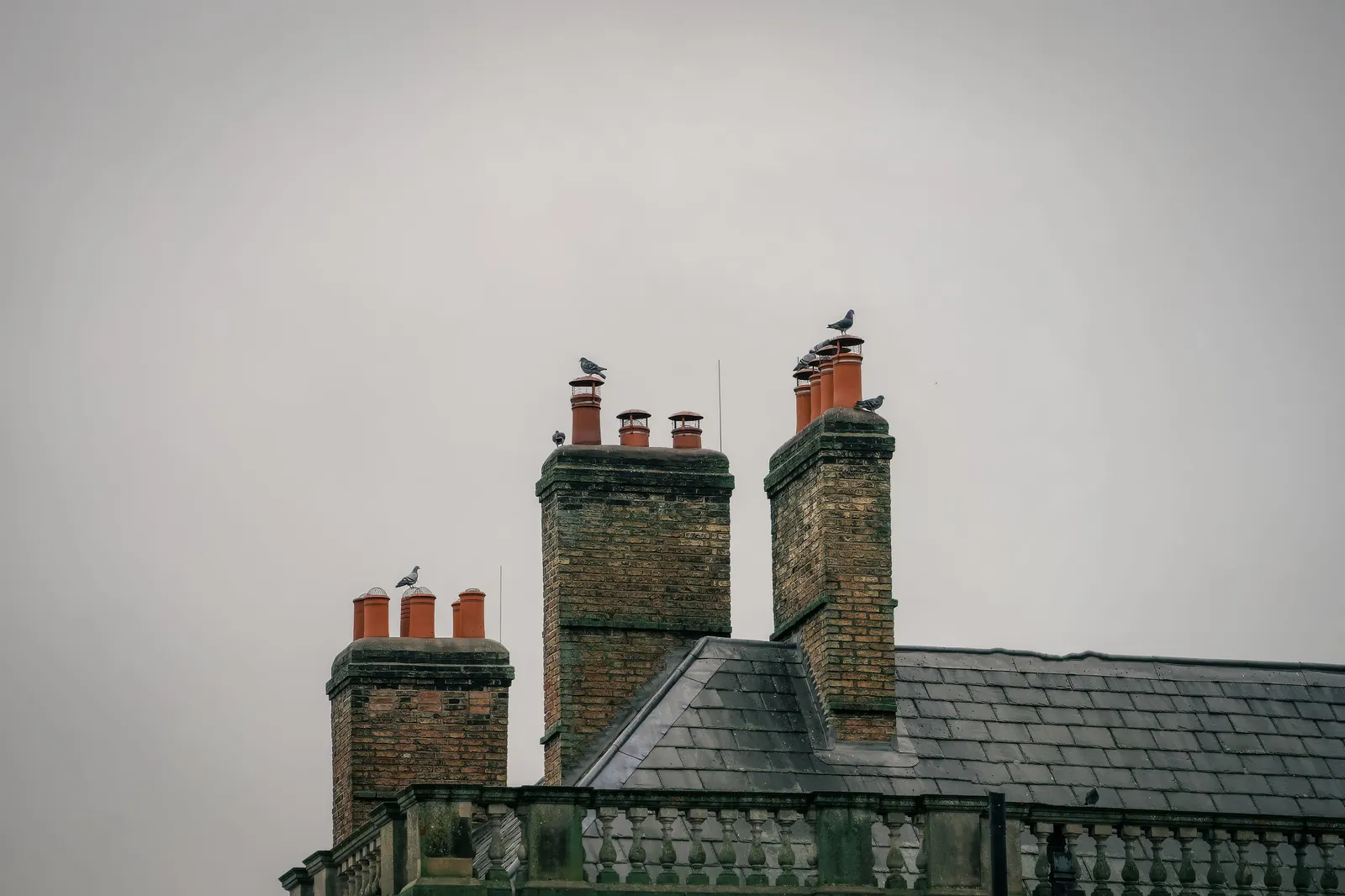
Why a chimney makes sound at all
A flue is a long, hollow tube with an open top. When wind crosses that opening, it pushes and pulls on the column of air inside, and at certain speeds the column starts to vibrate at its own pitch. Blowing across the neck of a bottle works the same way. A tall, narrow flue tends to give a lower hum; a short or partly blocked one, a higher whistle.
The masonry around the flue carries sound well and the firebox acts like a speaker cabinet. That is why a small loose part forty feet up can sound as if it sits just behind the fireplace screen, and why the noise in an attached house sometimes seems to come from the neighbor's wall.
Multi-flue chimneys, common on brownstones and rowhouses, can make several notes at once, because each flue has its own length and opening. A homeowner may hear a low drone from the fireplace on the parlor floor while the boiler flue next to it whistles in the basement, both from the same gust.
Whistling, humming and howling
A steady tone that rises and falls with gusts is air movement, not a broken part. The most common sources are an uncapped flue, a cap with fine mesh or narrow slots that whistles on its own when wind passes through, and a damper left slightly open so air rushes past the plate. Gaps around an old cast iron damper frame can add a second, thinner whistle at the fireplace.
Direction matters. Many homeowners notice the noise only in a northwest wind in winter or during an easterly nor'easter, when the wind hits the chimney top from the side that has the least shelter from neighboring roofs. That pattern is useful information, because it narrows down which side of the cap or crown is involved.
Rattles, bangs and clanks
A rattle that comes and goes with each gust is loose metal. It tends to start quietly, as a fastener rusts or a seal shrinks, and grows louder each season as the part works itself looser. These are the usual suspects, roughly in order of how often they turn up on older brick chimneys:
- A cap with rusted or stripped fasteners lifting off the flue tile or crown
- A cast iron throat damper plate rocking on worn pivots
- A top-sealing damper lid that does not latch fully closed
- Step or counter flashing that has pulled out of the mortar joint
- A metal chase cover or storm collar working loose
- A liner or boiler connector pipe moving inside the flue
Sounds that are not the wind
Scratching, scurrying or chirping, especially at dawn and dusk, usually means birds, squirrels, bats or a raccoon. It happens most in flues with no cap or with a torn screen. Do not light a fire to drive an animal out; nests burn, trapped animals can die in the flue, and both can block it. Raccoons in spring often have young on the smoke shelf.
Ticking and popping when the heat comes on is metal expanding as it warms: a stainless liner, a boiler connector or a sheet metal chase. That is normal unless it is new or getting louder. A sharp ping during a storm with no wind is usually rain striking a metal damper plate, which tells you water is reaching it and the cap or crown needs attention.
What you can check from inside and from the ground
Start by closing the damper firmly. If a whistle stops, the noise was air moving through the flue, and a tighter-sealing damper or a different cap will likely solve it. If the noise continues with the damper shut and is clearly coming from above, it is on the top of the chimney.
From the ground, use binoculars on a calm day. Look for a cap that sits crooked, a gap between the cap and the crown, flashing that has lifted, or a missing screen. Write down when the noise happens, the wind direction from a weather report and which room it is loudest in. Leave the roof itself to someone with fall protection; chimney tops are steep, high and often slick.
Why the noise is worth fixing
A rattling cap is a cap on its way off. A strong gust can tear it free and send it onto the roof, the gutter or the sidewalk below, and the flue is then open to rain, leaves and animals. Loose flashing makes noise and lets water in at the same time, often into the ceiling or wall beside the chimney.
A whistle alone is mostly a nuisance, but it usually means the flue is open or the damper is not sealing. Both cost heat on cold nights and let damp air drift down into the room, which brings the smoky smell of old creosote with it.
Timing matters too. Fasteners and flashing that are already loose in autumn take a beating in the first winter storms, and a part that only rattles in October can be gone by February. Repairs on a cold, icy roof are harder and slower, so a noise that starts in the fall is easier and safer to deal with before the heating season is fully under way.
How chimney noise is quieted
Loose caps are refastened with corrosion-resistant hardware or replaced with one that fits the flue and anchors properly. Where wind crossing the flue is the cause, a cap with a solid top and baffled sides breaks up the airflow. A top-sealing damper closes the flue at the top, which ends both the hum and the downdraft of cold air.
A rocking throat damper can be adjusted, have its pivots repaired, or be replaced. Flashing that has pulled out is reset into the mortar joint and sealed, and chase covers are refastened or replaced if rust has thinned them. For an animal, removal comes first, then a cap with mesh on every side.
What the visit looks like
A technician starts with your notes on timing and wind, then looks at the damper from the firebox and the top of the chimney from the roof. Every fastener on the cap, the condition of the crown under it, the flashing and any chase cover gets checked by hand, since loose parts often look fine until they are moved.
If an animal is involved, the smoke shelf and the base of any heating flue are checked as well. You get a plain explanation of what was making the noise and, if a part has to be replaced, the price in writing before the work is done.
Common Questions
Why is my chimney rattling?
How do I stop my chimney from whistling?
Why does my chimney howl only in certain winds?
Is a noisy chimney dangerous?
Can a chimney cap make noise?
Need help with this? See our caps & crowns service, or call (844) 468-2410 for a free written estimate.

