
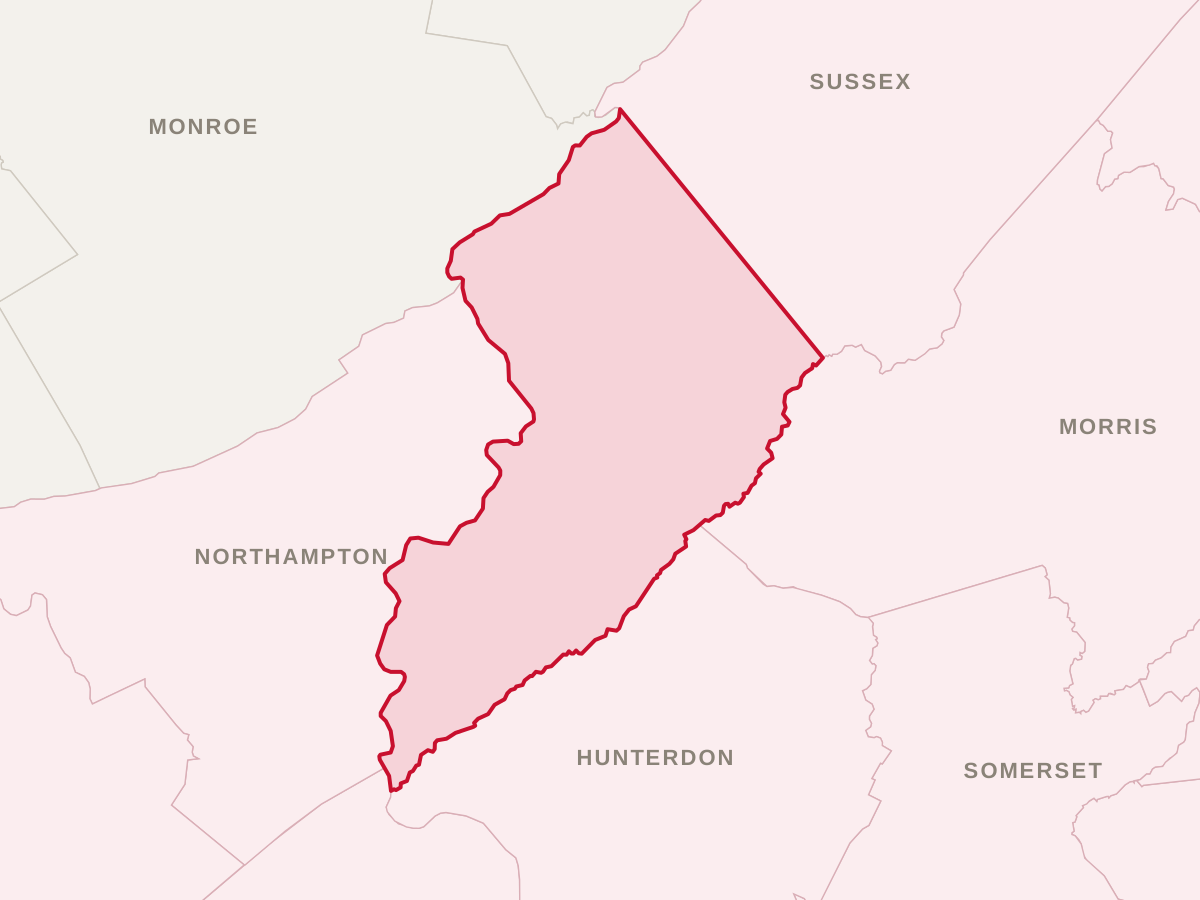
 Warren County
Local guide
Chimney Care in Warren County, NJ: What Local Homeowners Should Know
About a quarter of Warren County's homes predate 1940, and in Phillipsburg it is more than half. Fuel oil heats about a quarter of homes countywide and two-thirds in Blairstown, so many chimneys vent a boiler. Belvidere's January lows average about 19 degrees. Inspect every year, clean oil flues as needed and check old liners before relying on them.
Canal towns, rail towns and Victorian streets
Warren County has an unusually old housing stock: Census estimates for 2024 put about 25% of its homes before 1940. Phillipsburg, the largest town, sits where the Lehigh River meets the Delaware across from Easton, Pennsylvania, and grew as the Delaware River end of the Morris Canal and later as a rail hub. Its median home was built in 1938, and about 51% of its housing units date from before 1940.
In the borough of Washington, organ and other musical instrument makers drove a busy downtown in the late 19th and early 20th centuries, and many of its Victorian-style houses were built in that period. Hackettstown, once called Helms' Mills, was incorporated in 1853, and about 23% of its housing is prewar. Blairstown's older Main Street is anchored by Roy's Hall, built in 1913 as a silent movie house.
Newer housing shows up in places like Lopatcong, where the largest share of homes, about 23%, went up in the 2000s.
Oil heat in the valleys
Fuel oil heats about 25% of occupied homes countywide, according to Census estimates for 2024, with utility gas at about 52%, electricity about 14% and propane about 5%. In the northern townships oil dominates: about 67% of Blairstown homes burn it. In Phillipsburg, Hackettstown and Washington, gas is the main fuel, though oil still heats 8 to 17% of homes there.
An oil boiler sends soot and scale up the chimney all winter, and the flue needs cleaning when those deposits build up. A burner that is out of adjustment can make far more soot, so oil homes do well to pair the chimney visit with the yearly boiler service.
What old Warren chimneys need
Prewar chimneys bring a predictable set of issues, and Warren has a lot of them.
- Many chimneys built before 1940 have no liner, or clay tiles that have cracked; an inspection should confirm what is inside before a boiler or stove relies on it.
- Old brick and lime mortar are soft, so repointing should use a compatible mortar rather than a hard cement mix.
- In Victorian houses with several chimneys, each flue in use needs checking, and unused ones should be capped.
- Where gas replaced oil, the chimney may need a liner sized to the new furnace or water heater.
- Chimneys, fireplaces and vents should be inspected at least once a year, the interval NFPA 211 sets.
Ridge-and-valley weather
Warren County has rolling hills with the Kittatinny Ridge on the west and a humid continental climate. It lies in two valleys of the Great Appalachian Valley, the Kittatinny Valley in the north and the Lehigh Valley along the south. In Belvidere, the county seat, average January lows are about 19 degrees Fahrenheit, and the record low is 17 below zero, from January 1994. Hackettstown runs colder than Phillipsburg, with a January average of about 27 degrees against 29. Monthly precipitation ranges from about 2.8 inches in February to 4.7 inches in July.
Freeze-thaw is the main threat to masonry here. Water that gets into a cracked crown or worn joint freezes, expands and pushes the brick apart, and soft prewar brick gives way faster than modern brick. A tight crown, a cap and sound flashing keep most of that water out.
Approvals for Warren's historic homes
The Phillipsburg Commercial Historic District and the Blairstown Historic District, listed in 2007, are on the National Register. Where a home is landmarked or inside a district the town regulates, changes to the chimney's exterior can need approval from the local historic preservation body. For other homes, check with your town's building department about permits before a rebuild or relining.


