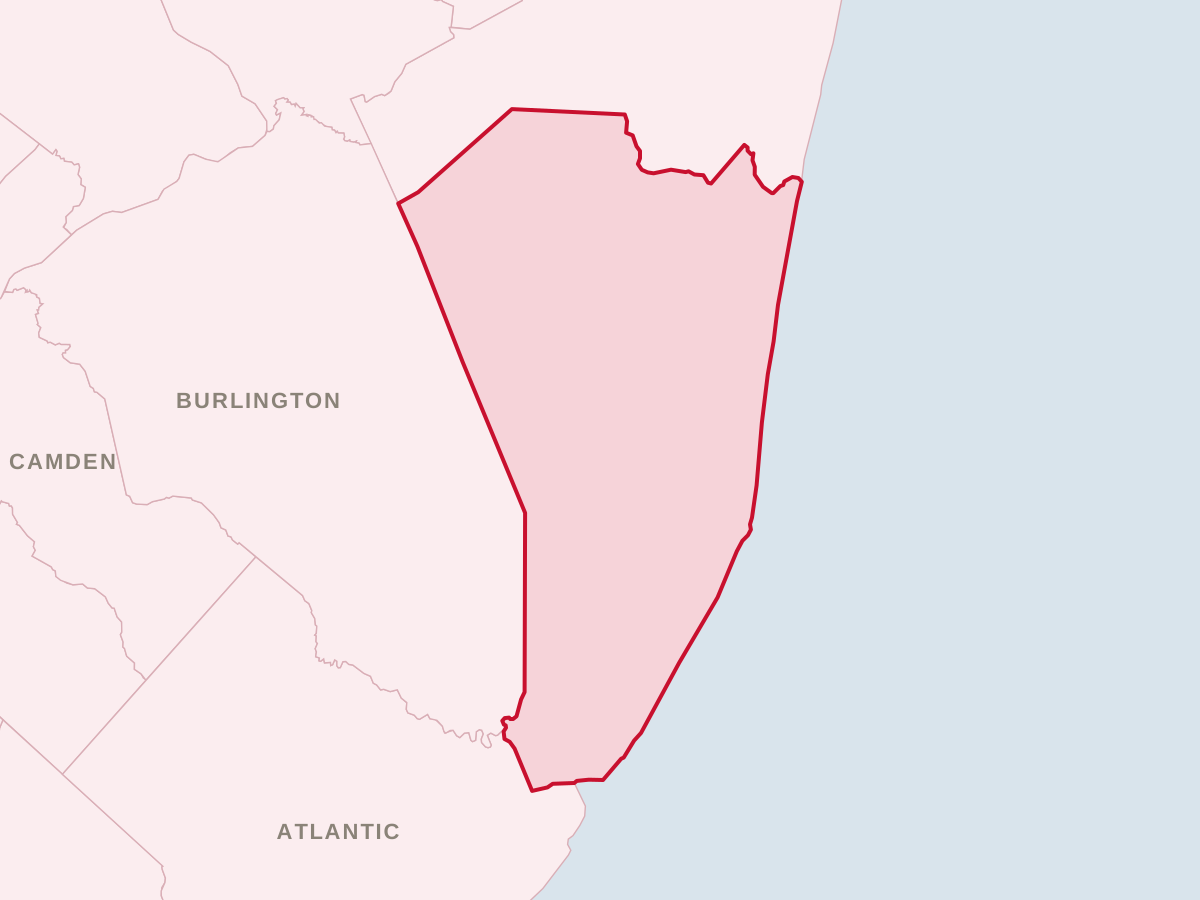
 Ocean County
Local guide
Chimney Care in Ocean County, NJ: What Local Homeowners Should Know
Much of Ocean County was built after the Garden State Parkway opened in 1954, so many chimneys are now old enough for worn crowns, tired flashing and aging flue liners. Add wind and salt air off the ocean and Barnegat Bay, plus wet springs, and a yearly look at the cap, crown and liner is the simplest way to stop leaks early.
Bay wind, salt air and a wet March
Almost a third of Ocean County is water: 31.3 percent of its area lies in the ocean, Barnegat Bay and the waterways around them. That fact shapes chimney wear here more than any other. Towns on the bay and the barrier beaches take steady wind and salty air, which works on metal caps, chase covers and the screws that hold them down. Rain falls through the whole year, and March is the wettest month on average at about 4.79 inches.
Winters are gentler near the water, but not gentle enough to spare masonry. Toms River averages a January low of about 24 degrees, so wet brick and mortar freeze and thaw again and again over a season. Big storms add their own damage. August 2011, the month Hurricane Irene reached the New Jersey coast, set the county record for monthly rain at 15.67 inches, and the 2012 surge from Sandy gave low parts of Toms River, including Silverton and the downtown, their worst flooding ever.
Parkway-era neighborhoods with older corners
The county grew quickly after the Garden State Parkway opened in 1954, as people who worked in North Jersey moved farther from the cities. Brick's housing boom ran from the 1950s through the 1980s and produced neighborhoods such as Lake Riviera, Laurelton and Baywood. In Jackson, home building rose from about 100 houses a year in the late 1950s to an average of 750 a year in the 1960s. Manchester Township holds large communities such as Crestwood Village, Leisure Village West and Cedar Glen Lakes, plus Pine Lake Park, built around a lake made in the 1970s.
Ocean County is older than those subdivisions suggest. Lakewood became a fashionable winter resort after it took its name in 1880, and George Jay Gould's 1896 estate is now Georgian Court University. Toms River has National Register houses such as the Captain Amos Birdsall House, and Jackson's Cassville Crossroads Historic District, where Routes 571 and 528 meet, was added to the National Register in 1982.
One chimney, two jobs
In many ranches and split-levels from these decades, a single masonry chimney carries a fireplace flue for the living room and a second flue for the furnace, boiler or water heater. Each wears differently. Wood fires leave creosote on the flue walls, while gas and oil appliances send warm, moist exhaust up the chimney, and when that moisture condenses on a cold clay liner it slowly attacks the tile and the mortar joints. Replacing an old heating system with a more efficient one can leave the existing flue the wrong size for it, which is a common reason a chimney gets a new liner.
What to watch near the shore
Salt and wind make the top of the chimney the first place to look. A rusting cap, a cracked concrete crown or flashing that has pulled away from the brick will let water in long before a stain shows on a ceiling. Stainless steel and copper hold up to salt air better than painted or galvanized steel.
- A cap with mesh over every flue, to keep out rain, birds and animals
- A crown with no cracks, sloped so water runs off the brick
- Tight flashing where the chimney meets the roof
- Mortar joints with no gaps or crumbling, especially on the side facing the wind
Before work on a Toms River or Lakewood landmark
The NFPA 211 standard calls for chimneys, fireplaces and vents to be inspected at least once a year, and again after a chimney fire or any event that may have caused damage. Along this coast, a hurricane or a hard coastal storm is that kind of event. If your house is a designated landmark or stands in a historic district, ask the local historic preservation body whether changes to visible masonry need its approval. Otherwise, check with your town's building department. Pro 1 Chimney is family-owned, with our own licensed and insured crew, and we explain what we find before any work is booked.