 Hudson County
Local guide
Chimney Care in Hudson County, NJ: What Local Homeowners Should Know
Hudson County packs old masonry row houses, brownstones and two-family homes next to new waterfront towers. Almost three in ten homes predate 1940, and the county sees rain or snow on about 116 days a year. For older buildings, yearly inspections, sound crowns and caps, and a correctly sized flue liner are what keep chimneys working.
Row houses, brownstones and two-families
Hudson County's older housing is dense and mostly masonry. Hoboken's 19th-century grid was laid out with masonry row houses of three to five stories, some still standing, and turn-of-the-century brownstones there were snapped up in the late 1970s and 1980s. Union City has long been made up largely of brownstones and two-family homes. Jersey City keeps Dutch-era houses such as the Newkirk House from 1690, along with row-house neighborhoods in its historic districts.
Recent Census estimates put about 29% of the county's housing units in buildings from 1939 or earlier, and about 13% from the 2010s alone, a sign of how much new building has come to the waterfront. Kearny and Weehawken each have about 38% of their housing from before 1940, while Harrison and Secaucus are much newer.
Up on the Palisades, Weehawken's private homes were mostly built in subdivisions such as Highwood Park and Clifton Park after the large estates gave way around 1900. Bayonne has about 36% of its housing from before 1940 and North Bergen about 29%, while Secaucus, the county's most suburban town, includes Harmon Cove, built in the 1970s.
A wet climate on the water
Hudson County has precipitation on an average of 116 days a year, with about 48 inches of rain and 26 inches of snow annually. Average January lows in Jersey City are around 27 degrees, so winter nights regularly dip below freezing, and wet brick freezes and thaws again and again. The Palisades in the north put Weehawken, West New York and North Bergen rooftops in strong wind, and much of the shoreline sits on reclaimed land along the rivers and bay.
Bayonne sits on Bergen Neck, a peninsula between Newark Bay, the Kill Van Kull and New York Bay, and its chimneys take salt air from several directions. Caps and fasteners rust faster in that air, so a corrosion-resistant cap in stainless steel or copper lasts longer there than plain steel.
Keeping a row-house chimney healthy
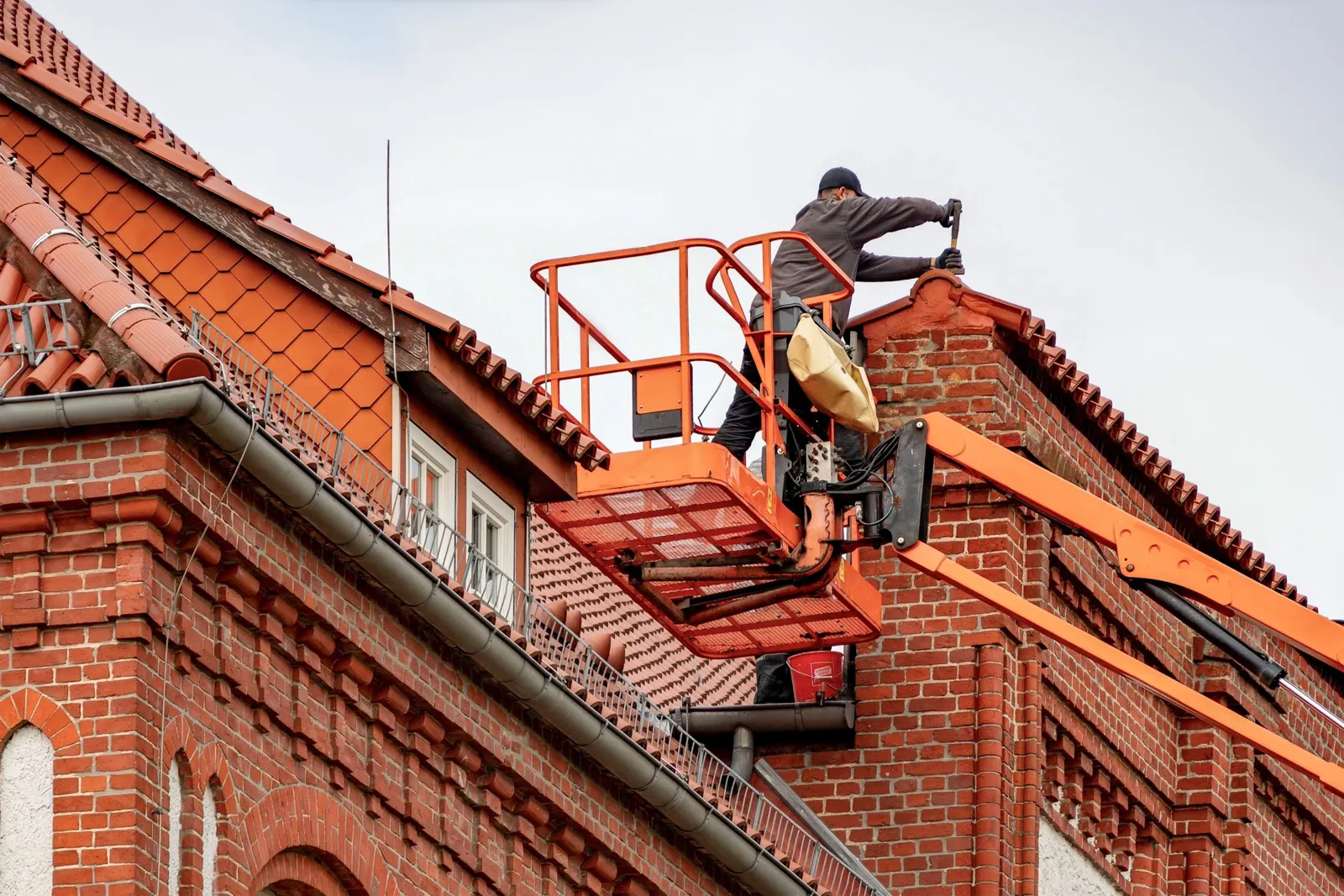
On a row house, the chimney is usually a tall masonry stack rising from a flat roof, often shared with or right beside the neighbor's. Water gets in at the crown, the cap and the flashing, and it shows up as stains on top-floor ceilings or crumbling mortar on the stack.
NFPA 211 sets the baseline: inspect chimneys, fireplaces and vents at least once a year, clean when deposits build up, and inspect again after a chimney fire or event that may have caused damage. In older Hudson buildings it also helps to confirm every active flue is lined and capped.
Historic districts in Hudson County
Jersey City has several historic districts, among them Paulus Hook, Van Vorst Park, Hamilton Park, Harsimus Cove and West Bergen-East Lincoln Park. Weehawken has King's Bluff. For a locally designated property, exterior chimney work can need approval from the city's historic preservation commission. Elsewhere, check with your town's building department about permits.
Kearny's Highland Hose No. 4 firehouse from 1895 and West New York's Excelsior Engine Co. No. 2 firehouse are on the National Register as well.
Gas boilers and electric heat
Recent Census estimates show utility gas heating about 66% of occupied homes in Hudson County and electricity about 28%, with fuel oil around 2%. In a gas-heated brownstone, the chimney's main job is venting the boiler and water heater. Gas exhaust is full of water vapor, and in an unlined or oversized masonry flue it condenses and erodes mortar from the inside. Homes that switched to electric heat may have flues that are no longer used and should be capped so they do not collect water.
Electric heat is common in parts of the county: about 39% of homes in Hoboken, 37% in Harrison and 32% in Jersey City. Harrison also has about 7% of homes on propane, which vents much like natural gas.