
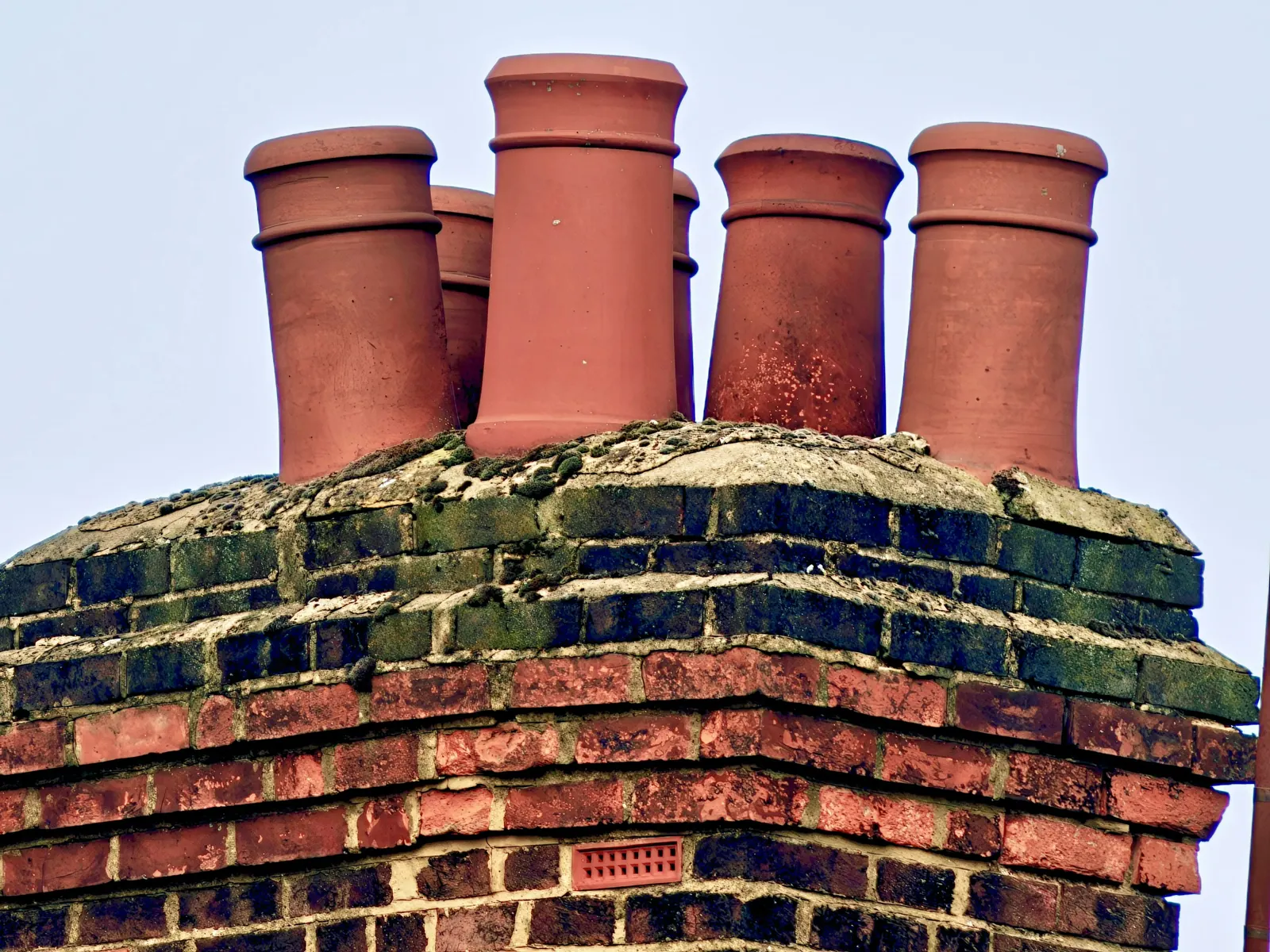
What repointing means
Mortar is the sacrificial part of a brick wall. It is meant to be softer and more porous than the brick and to wear first, so that the joints, not the bricks, take the weather and let moisture out. Over time the joints turn sandy, shrink back from the brick edges and open up. Repointing is the cure: cut out the failed mortar to sound material, clean and dampen the joint, and pack in new mortar in layers before tooling the face to the right shape.
It is the same job on a chimney, a front wall or a garden wall. The mortar mix, the depth of the cut and the joint shape are what make it good or bad work, and none of them show in a photo taken the day it is finished.
What tuckpointing originally means
Tuckpointing started in Britain as a way to make rough, uneven brickwork look like expensive, finely laid brick with very thin joints. The joints were filled with mortar tinted to match the brick, so the real joint almost disappeared. Then a narrow groove was cut along the middle and a thin ribbon of lime putty, usually white or a contrasting color, was tucked into it and trimmed to a crisp edge.
From the street, the wall looks as if it has perfectly straight, hairline joints. You can still see original tuckpointing on some older facades in New York and Philadelphia. Restoring it is a specialized and slow craft, and it is usually done on front elevations rather than chimneys.
- Purpose: repointing repairs worn joints, while strict tuckpointing creates a crisp-joint effect
- Mortar: repointing uses a mix matched to the brick, while tuckpointing adds a contrasting ribbon over a brick-colored base
- Where used: repointing on any brickwork, chimneys included; tuckpointing mainly on historic facades
- Skill and time: repointing is standard masonry work; tuckpointing is specialized and slower
Why the words get mixed up
In much of the US, especially among chimney and masonry contractors, tuckpointing has become the everyday word for any mortar joint repair. Ask for tuckpointing on a chimney and you will almost certainly get repointing, which is what you want. Ask for repointing on a historic facade with ribbon joints and the right contractor will ask whether you want the decorative line recreated.
If a quote uses either word, check that it describes the actual work: how deep the old mortar comes out, what mortar goes in, and how the joint is finished.
- Repointing: remove failed mortar, fill with new mortar, tool to match
- Tuckpointing, strict sense: color-matched mortar plus a thin contrasting ribbon
- Tuckpointing, everyday sense: another name for repointing
- Patching or smearing: mortar spread over old joints, not a real repair
How good repointing is done
The old mortar comes out to a consistent depth, typically about two to two and a half times the joint's width and always back to sound mortar, using grinders or hand tools that do not chip the brick edges. Dust and loose material are cleaned out and the joint is dampened so the brick does not suck the water out of the fresh mortar. Deep joints are filled in layers, each one firmed before the next, rather than in one thick pack that slumps.
When the mortar has stiffened to the right point, the joint is tooled to match the original profile: concave, flat, weathered or struck. The wall is then kept from drying too fast in sun and wind and protected from frost while it cures.
Bad repointing is easy to spot once you know what to look for: mortar smeared over the brick faces, joints that are only a few millimeters deep, a bright gray cement color against soft red brick, or new mortar already cracking away from the brick edges after one winter. Ask how the old mortar will be removed and to what depth before the work is agreed.
The part that matters most: the mortar
Whatever it is called, the new mortar has to suit the old brick. Many older houses in Brooklyn, Queens, Jersey City and Philadelphia were laid with soft brick and lime-rich mortar. Fill those joints with a hard, high-cement mortar and the joints become stronger and less porous than the brick. Then, when water freezes in the wall, the brick faces crack and pop off instead of the joints, which is far harder and costlier to fix.
A good mason matches the mortar's strength, color and texture to the wall and tools the joint to the same profile as the original. On historic properties, a lime mortar may be the only appropriate choice.
Signs a chimney needs repointing
From the ground with binoculars, look for joints that look deep and shadowed rather than flush, mortar crumbs on the roof or in the gutter, bricks that look loose, and white staining spreading from the joints. Up close, mortar that scratches away with a key or a screwdriver tip is spent. The top few courses of a chimney usually go first, because they take weather from every side, often while the joints lower down are fine.
Inside, damp patches on the chimney breast or in the attic beside the chimney after rain can point to open joints, although cracked crowns and failed flashing cause the same signs and should be checked at the same time.
Which one does a chimney need?
Almost every chimney needs plain repointing. Decorative tuckpointing on a chimney is rare and usually only makes sense where the chimney is part of a historic front that has it. Repointing is also not always the whole answer: if bricks have spalled, if the top courses are loose, or if the crown is cracked, those are dealt with in the same job so water does not undo the new joints.
When the top section is badly deteriorated, rebuilding it above the roofline can be more sensible than repointing loose brick. An inspection tells you which applies.
Timing the work
Mortar needs temperatures above freezing to cure properly, and lime mortars cure slowly, so chimney repointing in the Northeast is usually planned from spring through fall. Very hot, dry days are not ideal either, since mortar that dries too fast is weak. A good crew watches the forecast and protects fresh work from rain and frost.
On a chimney, the crew also needs safe roof access for the whole job, so scaffolding or roof brackets may be part of the plan on tall or steep stacks. That is one reason a written scope matters: it shows how the work will be reached as well as what will be done.
Common Questions
What does tuckpointing mean?
What does repointing brick mean?
Is brick repointing better than tuckpointing?
How deep should old mortar be removed?
Can I repoint my chimney with ready-mixed mortar from a store?
Need help with this? See our masonry & tuckpointing service, or call (844) 468-2410 for a free written estimate.

