 Bergen County
Local guide
Chimney Care in Bergen County, NJ: What Local Homeowners Should Know
Bergen County is mostly gas-heated, so the typical chimney vents a furnace or boiler rather than a wood fire. Housing peaks in the 1950s, with older stone and Victorian homes in Teaneck, Ridgewood and Englewood. Cold January nights drive freeze-thaw damage, so plan a yearly inspection and fix crowns and flashing early.
Bergen's weather, river to mountains
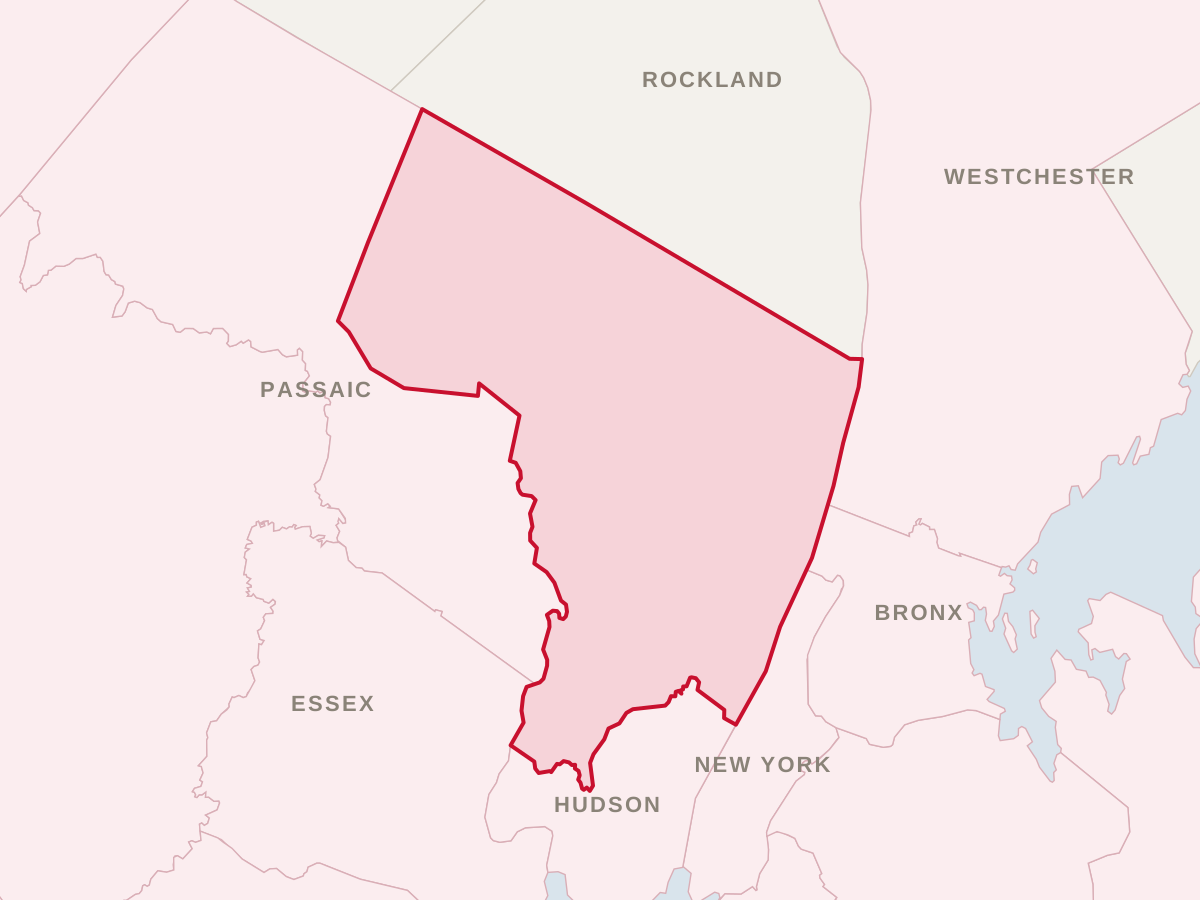
Bergen County's climate is milder than New Jersey counties farther inland, helped by its coastal location and lower elevation. It is still cold enough to hurt masonry. Average January lows in Hackensack are around 19 degrees, and the higher Ramapo Mountains near Mahwah have a cooler climate than the river towns. The Palisades lift the county's eastern edge up from the Hudson, putting Fort Lee's buildings high on the cliffs above the river.
Every freeze pulls water deeper into weak mortar. Over a few winters that shows up as cracked crowns, spalled brick and leaks at the flashing.
Rain is spread through the year, with average monthly precipitation in Hackensack ranging from about 3.2 inches in February to about 4.6 inches in July. Mahwah, at the county's northern edge, averages about 28.5 degrees in January, measured at Route 17 and MacArthur Boulevard.
Gas heat in most Bergen homes
Recent Census estimates show utility gas heating about 78% of occupied homes in Bergen County and electricity about 17%, with fuel oil under 3%. Town by town it can run even higher: about 88% in Paramus and 89% in Oakland. Some pockets keep oil, such as about 6% of homes in Teaneck and 5% in Englewood, and Oakland reports a small share heating with wood.
A gas furnace or boiler sends moist, relatively cool exhaust into the chimney. In a large masonry flue that moisture condenses, mixes with combustion byproducts and slowly eats at the mortar and liner. That is why a gas-only chimney can deteriorate even though it never sees a fire.
Postwar streets and colonial stone
The 1950s are the county's busiest building decade, at about 19% of housing units in recent estimates, with a similar share from 1939 or earlier. Paramus is a good example: its median home dates to 1963 and about 35% of its housing went up in the 1950s. Fair Lawn and Bergenfield also peaked in the 1950s.
Older houses cluster in towns like Ridgewood, where about 38% of housing predates 1940, and Teaneck, at about 33%. Several Dutch stone houses from the 1700s still stand along Teaneck Road and River Road. Fair Lawn includes Radburn, planned in 1929, and Mahwah is much newer, with a median build year of 1984.
Closer to the city, the mix shifts. Hackensack runs from a mile-long strip of high-rise apartments on Prospect Avenue to older two-family blocks and single-family streets, and about 40% of its homes heat with electricity. Fort Lee's density rose with high-rise building in the 1960s and 1970s. Garfield, first developed in 1873 as East Passaic, has about 30% of its housing from before 1940, and Ramsey's Old Stone House dates from the early 1700s.
Simple steps for Bergen chimneys
Most of what keeps a Bergen chimney sound is routine, and it fits on a short list:
Stone needs care of its own. On a colonial sandstone house, hard modern mortar can trap water against the old stone, so repairs call for a softer mix suited to the masonry.
- An inspection at least once a year for chimneys, fireplaces and vents, following NFPA 211.
- Cleaning when deposits build up, more often for oil or regular wood use.
- A liner check whenever a furnace or boiler is replaced.
- Crown and flashing repairs before the next winter, not after the ceiling stains.
Historic homes and local approvals
Bergen has many individually listed historic houses, including the Terhune House in Paramus, the Ackerman homes in Ridgewood and the Thomas Demarest House in Englewood, plus districts like Radburn. If your property is locally designated, exterior chimney work can need approval from your municipality's historic preservation body. In every other case, check with your town's building department about permits before major masonry work.
Ridgewood's Paramus Reformed Church Historic District and Hackensack's Reformed Dutch Church and Green are other places where older masonry and local rules meet.