
How a clay liner is built
Flue tiles are hollow sections of baked clay, usually square or rectangular, sometimes round, stacked one on top of the next. Masons set them as the chimney rises, stacking one on another with a mortar joint at each seam and leaving a small space between the tile and the brick around it. The top tile usually stands a little above the crown.
That gap matters. Clay grows slightly as it heats, and the space lets it expand without pushing on the surrounding brick. It is also one reason clay liners are installed with the chimney and are hard to replace later: the tiles are locked inside the brickwork, and getting at one deep in the stack means opening the chimney.
Because the liner goes in with the original masonry, its condition tells the history of the chimney. Fires, water, fuel changes and settling all leave their marks on the tile.
What clay does well
Fired clay handles ordinary flue temperatures comfortably and resists the acids in wood, oil and gas exhaust far better than plain brick and lime mortar. The inside face is smooth, so smoke moves freely and soot and creosote brush off more easily than in an unlined chimney.
An intact clay flue of the right size for the appliance it serves, with tight joints and a crown and cap protecting the top, does its job and needs nothing more than the yearly inspection and cleaning that NFPA 211 calls for. Many of the clay flues in older New Jersey colonials and Philadelphia twins are still in that condition.
Before clay: the unlined chimney
Not every old chimney has tile inside. Many brick houses built before flue liners became standard practice have flues that are nothing more than the inside face of the brick, sometimes coated with a thin layer of mortar called parging. On older brownstones, Philadelphia rowhouses and early farmhouses, finding an unlined flue is common.
An unlined flue leaves the brick and soft lime mortar exposed to heat, soot and acidic condensation. The joints erode, gaps open between flues that share a wall, and exhaust can travel sideways into a neighboring flue or into the house. That is why an unlined flue is usually relined before it is used for a fireplace or a heating appliance, while a sound clay flue may need nothing at all.
Where clay liners fail
Clay is hard but brittle. It does not flex, so it cracks when something stresses it. In older homes across this region, the causes show up roughly in this order:
- Water at the top: rain gets past a cracked crown or an uncapped flue, soaks the upper tiles and freezes on cold nights
- Acidic condensation from gas and oil exhaust, which slowly erodes the mortar joints and the inner face of the tile
- Mortar joints washing out over time, leaving open gaps between sections
- A chimney fire, where sudden intense heat makes tiles crack or split lengthwise
- Settling of the house or chimney, which can offset tiles at the joints
Clay liners and modern heating appliances
A clay flue built for a coal furnace or a big old oil boiler is often far larger than a modern gas boiler or water heater needs. A small, efficient appliance sends cooler exhaust into that large flue. The exhaust slows down, cools further, and the water vapor in it condenses on the tile walls. That water is mildly acidic. Over seasons it softens the mortar joints and flakes the face of the tile, and the debris piles up at the foot of the chimney.
The same thing happens when a furnace or boiler is replaced and a water heater is left alone on a flue that was sized for both. In those cases the issue is not that clay is a bad material but that the flue no longer matches the appliance, and the usual fix is a correctly sized liner inside the old tile.
Oil heat adds its own wear. Oil exhaust carries sulfur, and the soot and scale it leaves behind hold moisture against the tile. A boiler flue that has not been cleaned for a few seasons often shows the damage first at the base and near the thimble, where the wet deposits sit longest.
How to tell if your flue is clay, and what damage looks like
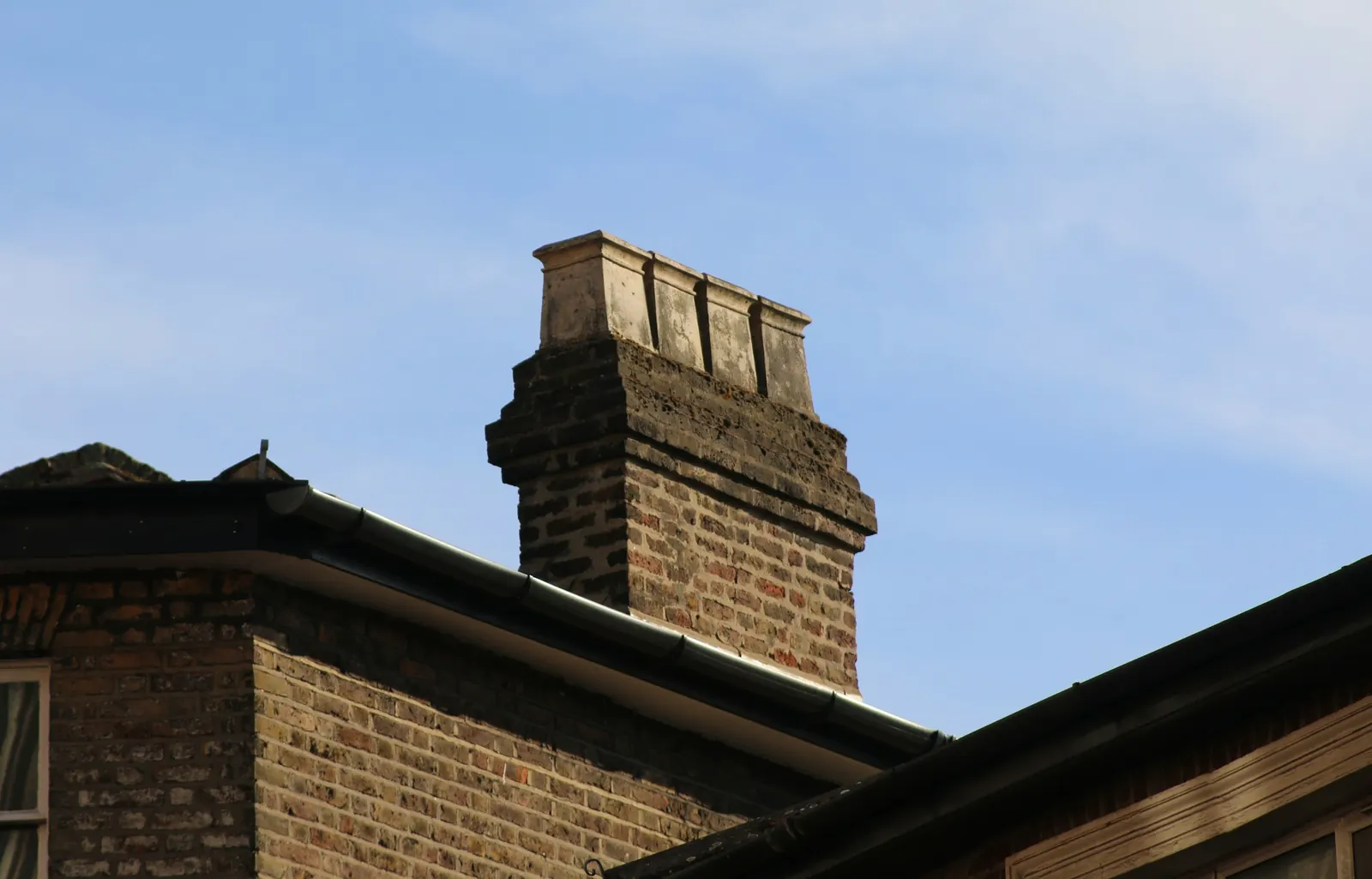
Seen from the street, the top of a clay-lined chimney usually shows the edge of a tile poking up above the crown, orange, tan or dark from soot. Inside, with the fireplace cold, a flashlight up past the open damper or into the cleanout shows smooth walls with a joint every couple of feet.
Some signs of trouble can be spotted without climbing anywhere:
- Curved orange or tan shards in the cleanout or on the smoke shelf
- Sand-like grit or crumbled mortar collecting in the cleanout
- White crust or rusty water stains around the boiler pipe where it enters the chimney
- A top tile that looks cracked, chipped or tilted when seen through binoculars
Repair options and where each one fits
What makes sense depends on where the damage is, how much of the flue is affected and what the flue will serve from now on.
- Resurfacing with a heat-resistant coating: suits small joint gaps or minor wear in an otherwise sound flue, but does not fix broken, displaced or missing tile
- Replacing the top tile: suits cracking limited to the exposed section above the crown, and leaves any damage lower down untouched
- Stainless steel liner inside the old tile: suits widespread cracks, a wrong flue size or a new appliance, sized and installed to the appliance's instructions
- Cast-in-place liner: suits rough or irregular flues where a poured lining fits the chimney, and is a larger job that cures inside the old flue
- New clay tile: suits a chimney already being rebuilt from the roofline up, since the brick has to come down to reach the tile
Deciding what to do, and how urgent it is
A cracked tile is not a cosmetic issue. Gaps in the liner let heat reach the brick and any wood framing nearby, and they let exhaust leak into the chimney structure, where it can find its way into rooms or the attic. A flue with open cracks after a chimney fire stays out of service until it is repaired. A boiler flue shedding tile into the cleanout should be dealt with before the next heating season, because the debris can eventually block the base and push exhaust back into the basement.
Minor wear at a few joints in a fireplace flue that sees light use is a lower priority, but it is worth fixing while it is small. Water getting in at the top is usually the root problem, so the crown and cap are part of almost every clay liner repair.
During an inspection we look at the flue from the top and the bottom, check the tiles and joints, and match the flue size to what it serves. You see what we found and get a written estimate covering the options that genuinely fit the chimney.
Common Questions
Do old chimneys have clay flue liners?
Is a clay flue tile liner safe for a gas boiler?
Can a clay flue liner be cleaned like any other flue?
How long does a clay flue liner last?
Can a cracked clay liner be relined without removing the tiles?
Need help with this? See our chimney liners service, or call (844) 468-2410 for a free written estimate.

