
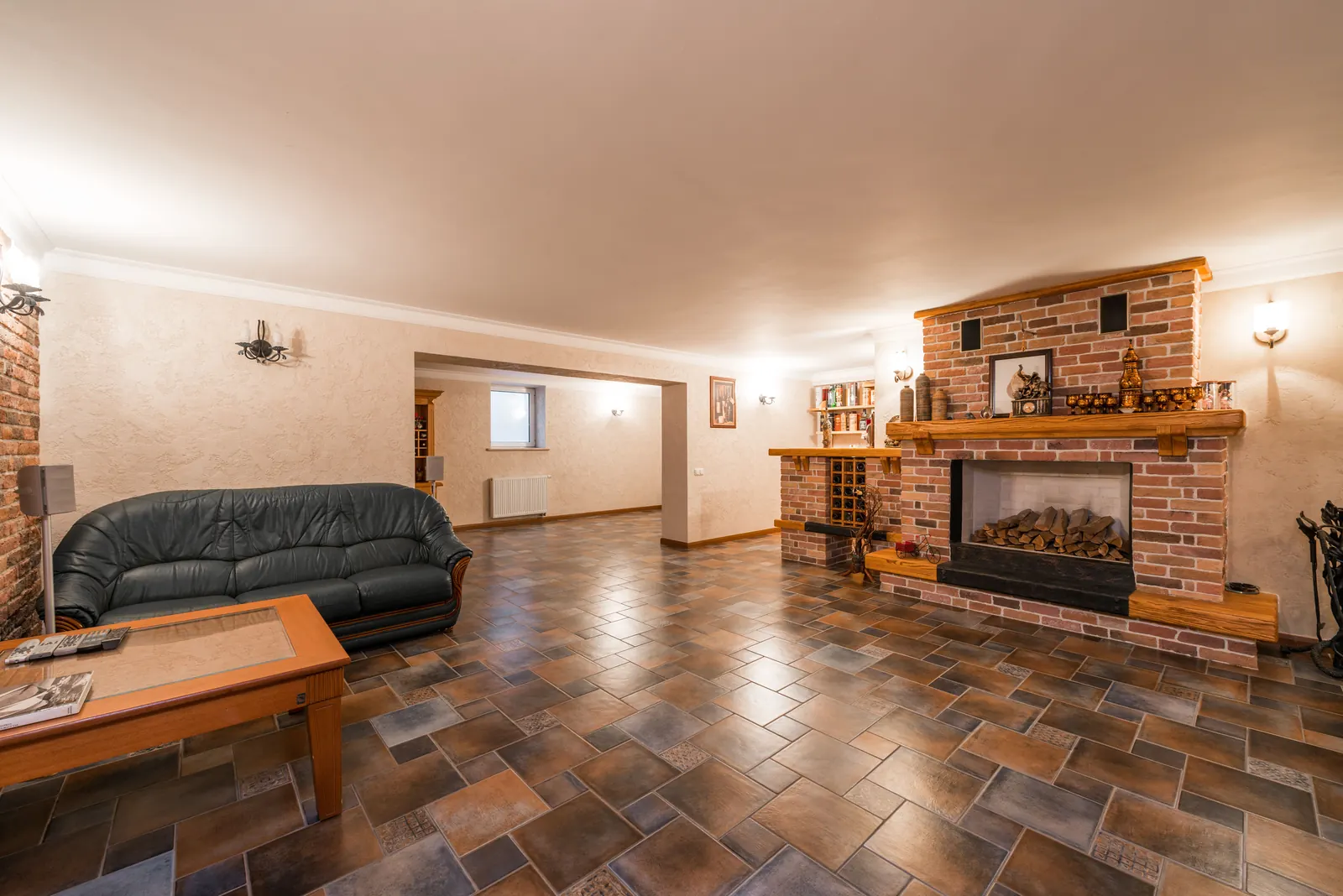
Two different surfaces: the inner hearth and the extension
The inner hearth is the floor of the firebox, the surface the fire actually sits on. It is built from firebrick or a refractory slab and takes direct flame. The hearth extension is the noncombustible slab that runs out in front of the opening and into the room, there to catch rolling logs, sparks and spilled ash.
The two crack for different reasons and get judged differently. A cracked firebox floor is a heat question and belongs with the rest of the firebox inspection. A cracked extension is mostly a support question: what holds the stone up, and whether that support is still doing its job. Most homeowners notice the extension first, because it is right there in the living room.
What holds an old hearth up
In many brownstones, Philadelphia rowhouses and older colonials, the hearth extension does not rest on the wood floor at all. It sits on a shallow brick arch, called a trimmer arch, sprung between the chimney and a header joist, with a bed of mortar or concrete on top and the stone laid over that. From the cellar or the floor below you can sometimes see the curved brick underside.
Newer or remodeled houses often use a concrete pad poured into a framed opening, or a slab set on a layer of backer board over the subfloor. Each of these can fail. Old arches lose mortar and drop slightly, joists beside the opening sag after a century of load, and a thin mortar bed leaves voids under the stone. When the support moves, the stone above it cracks along the weakest line.
Common causes, from most to least frequent in older homes
A crack is a symptom, so the cause decides the repair. In nineteenth- and early twentieth-century houses, the order below matches what a technician tends to find when the floor is opened up.
- Settling of the support: a trimmer arch or concrete pad that has dropped, or joists that have sagged beside it
- Voids in the setting bed, so the stone spans a hollow spot and snaps under foot traffic
- Heat stress at the front edge, where stone close to the opening expands faster than the rest of the slab
- Impact from a dropped log, andiron or tool, which chips edges and can start a fracture
- Renovation damage, such as a joist notched for a pipe or a floor leveled without allowing for the hearth
Telling a cosmetic crack from a structural one
A fine line that does not catch a fingernail, has both sides at the same height and stays the same width through a heating season is almost always cosmetic. Cracked grout between tiles that are still tight, a chipped corner, or crazing in a glazed tile fall into the same group. Marble often shows veins that look like cracks but are part of the stone.
Movement is the dividing line. When one piece sits lower, the slab rocks, or the crack has opened enough to see into, the support has shifted. The table sets out the usual readings.
| What you see | Likely meaning | What to do |
|---|---|---|
| Hairline line, flat, not growing | Flaw or shrinkage in the stone | Monitor; fill for looks if you like |
| Cracked grout, tiles tight | Grout aging or minor flexing | Regrout |
| Crack you can see into | Base has moved or has voids | Have the support checked before burning |
| Slab rocks or sounds hollow | Setting bed failed under the stone | Lift, rebed or rebuild the base |
| One side lower than the other | Arch, pad or joists have dropped | Inspect from below; structural repair |
| Scorch marks or wood visible | Combustibles exposed under the hearth | Stop using the fireplace now |
Why a wide crack is a fire question
The danger is not the stone; it is what lies beneath it. If any wood framing, flooring or old subfloor sits under the extension, a wide crack gives embers and hot ash a path straight down to it. Ash can hold heat for many hours, and a smoldering spot under a hearth can go unnoticed until the smell reaches another room.
Older houses that have been renovated sometimes have wood closer to the hearth than the original builders intended, because new flooring was run up to the stone or a subfloor was added. Any scorch mark around the edges, a burnt smell near the hearth when no fire is lit, or wood fibers visible through the gap are reasons to stop burning until the slab is lifted and the base is checked.
Gas fireplaces are not exempt. Gas logs rarely drop embers, but the hearth still carries the heat that rolls out of the opening, and a sinking slab can pull at the gas line or the firebox floor. The same checks apply, even if the fire risk from falling ash is lower.
What you can check yourself
Most of the useful observations take a few minutes and no tools beyond a flashlight and a pencil. Do them with the fireplace cold.
- Run a fingernail across the crack; a nail that catches means the edges are no longer level
- Mark both ends of the crack with a light pencil tick and the date, then check again in a few weeks
- Step gently on each side and listen for a click or a rock
- Tap the slab with a knuckle; a dull, hollow note means a void below
- Look at the underside from the cellar or the floor below if it is exposed
- Shine a flashlight into the crack and along the edges for darkened wood
Repair options by material
A sound slab with a stable crack can usually be filled with a color-matched stone epoxy, then leveled and polished so the line nearly disappears. Granite takes this kind of repair well because it is hard and uniform. Marble can be filled too, though matching its veining takes patience. Slate is layered and tends to split along its grain, so a cracked slate piece is often replaced rather than glued.
Tiled hearths are repaired by cutting out the broken tiles, checking the bed beneath, and setting new ones with fresh grout. Matching old encaustic or glazed tile can be the hardest part, and salvaged tile is sometimes the closest match.
When the base has failed, the stone has to come up. The arch, pad or framing is repaired or replaced with a noncombustible base, then the original slab goes back if it survived the lifting, or a new one is cut to fit.
What the visit looks like
A technician starts below the hearth wherever possible, looking at the arch or pad and the joists around it, then checks the slab for movement, hollow spots and heat marks. The firebox floor and the front of the opening are looked at at the same time, since a cracked inner hearth often travels with loose firebrick or open mortar joints. The extension's size relative to the opening is noted too, because older hearths were sometimes built shallower than current rules expect.
You then get a plain explanation of which kind of crack you have and what the repair involves, from a filled line to a new base, written up as a free estimate you can compare.
Common Questions
Can a cracked hearth be repaired without replacing it?
Is a cracked slate hearth repair different from granite?
Is it safe to use a fireplace with a cracked hearth?
Why did my marble hearth crack near the fireplace opening?
Does a cracked hearth mean the chimney is settling?
Need help with this? See our fireplace repair service, or call (844) 468-2410 for a free written estimate.

