
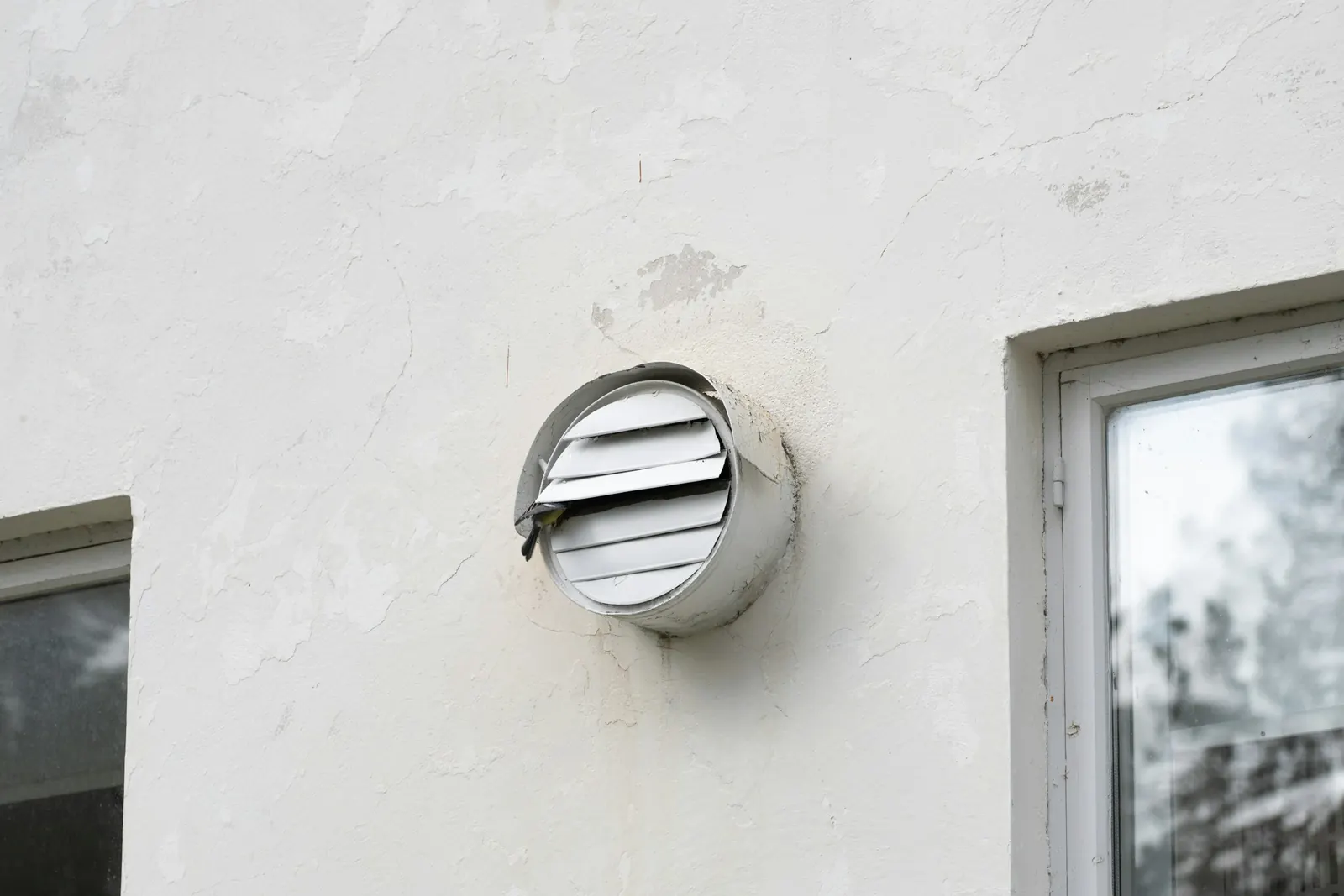
What the flap is for
The flap, or the row of louvers, on the outside hood is a backdraft damper. When the dryer runs, the exhaust pressure pushes it open. When the dryer stops, gravity or a light spring lets it fall shut, closing the duct against wind, rain, cold air and anything looking for a warm place to nest.
Building codes call for a backdraft damper where a dryer duct ends outdoors, and they rule out screens over the outlet because screens catch lint. A hood with a working flap and an open path for air is part of a correct installation, not an accessory.
Hood styles and how each one fails
Not all hoods close the same way, and the style tells you where to look when one misbehaves. A single hinged flap falls shut by its own weight and usually fails at the hinge, where lint collects, or by warping and cracking. Louvered hoods have several small blades that each drop shut, and lint wedges between them. Spring-loaded flaps rely on a light spring that can rust or break, leaving the flap hanging open. Hoods with a pest grid or grille put a screen in front of the flap, and the grid packs with lint.
Louvered hoods look tidy, but each small blade is another edge for lint to catch on, and a single blade that sticks shut narrows the outlet. A single wide flap that opens fully under the dryer's own airflow usually passes lint more freely. Grilles sold as pest guards trap lint fastest of all, and they are a common reason a dryer that was cleaned recently is slow again.
Why a flap gets stuck open
Lint leaves the dryer warm and damp. At the outlet it meets cold air, clings to the hinge and the edges of the flap, and dries into a stiff felt. A little more arrives with every load, until the flap rests on it and cannot close. In our experience this accounts for most of the open flaps we find, with the others following roughly in this order.
- Lint packed around the hinge or louver edges
- A flap bent, cracked or warped by sun, heat or a stray ball
- Exterior paint gluing the flap open or shut
- Ice or packed snow holding it open in winter
- A broken spring or hinge pin on a spring-loaded hood
- A light plastic flap that wind keeps catching
When the flap will not open
A flap stuck shut, or louvers jammed solid with lint, is the more serious problem. The dryer pushes against a closed door, airflow collapses, drying slows and lint backs up through the duct toward the machine. The laundry room gets hot and humid, and lint can start to collect around the dryer door.
To check, start the dryer on a heat setting and go outside. If you feel little or no air at a ground-level hood, the hood or the duct just behind it is blocked. Stop using the dryer until it is cleared, because heat and lint are building up exactly where they should not.
What you can do from the ground
If the hood is at ground level, turn the dryer off first. Pull out the lint you can reach around the flap with a gloved hand or a soft brush, clear between the louvers, and check that the flap swings freely and drops shut on its own. Look up into the opening with a flashlight for a nest or a wad of lint just behind the flap.
Skip the oil. Lubricant on the hinge holds lint and makes the next jam worse. Do not tape the flap shut, stuff it with steel wool or add a screen to stop pests, since all of those block the exhaust the next time the dryer runs. A hood high on a wall, over a stoop or on the roof is a ladder or roof job, and that belongs to someone with the right gear.
Winter, snow and low hoods
Many older homes vent the dryer through the foundation wall a few inches above grade, under a front stoop or into a window well. In a nor'easter, drifting snow or a pile from shoveling the walk can bury the hood, and ice can freeze the flap open or shut. Check a low hood after every heavy snowfall before running the dryer, and clear the snow away from it by hand.
A flap frozen open in a cold snap lets frigid air run back down the duct, which also chills the run and adds condensation inside it. If ice keeps forming, it is often a sign that warm, wet exhaust is lingering at the outlet because the airflow is weak.
Birds, mice and gaps around the hood
An open flap is an invitation. Birds nest in the warm hood in spring, and mice can follow a duct into a wall or ceiling. On brick and stone homes, the gap where the duct sleeve passes through the wall is a second way in, especially where old caulk has dried out or mortar has crumbled around the opening.
If you see nesting material, droppings or chewed lint at the outlet, the hood needs clearing and the flap needs to close properly again. The gap around the sleeve should be sealed with a material suited to masonry so the fix lasts.
Repair the flap or replace the hood?
Cleaning fixes a flap held open by lint or paint. A bent, cracked or warped flap, a broken spring, or a hood that has been painted over many times is usually past saving. Most flaps are molded or riveted into the hood, so replacing the whole hood is simpler than hunting for a matching flap, and a new one can be chosen for a full-size opening and a flap that closes cleanly.
On masonry walls, swapping a hood means removing the old fasteners and sealant without damaging brick, fitting the new hood to the existing duct size, and resealing the perimeter so water does not run behind it.
Why the flap keeps clogging
A flap that sticks again a few weeks after cleaning is pointing back up the line. A long run, a crushed transition hose, or a duct that has not been cleaned in a long time sends more lint to the outlet than a healthy system would. Cleaning the whole duct, not only the hood, is usually what ends a repeat problem.
The hood itself can be part of the cause. An opening smaller than the duct, a flap so heavy that the dryer barely lifts it, or a hood mounted where wind pins the flap shut all slow the exhaust at the very end of the run, and slow air drops lint right there.
When we handle one of these, the run is cleaned from the dryer to the outlet, a worn hood is replaced with one that seals, and the airflow is checked at the flap with the dryer running before we leave.
Common Questions
Is a dryer vent flap stuck open a problem?
Can I replace just the dryer vent flapper?
What do I do if the dryer vent flap is broken?
Why does my dryer vent flap stay open when the dryer is off?
Should I put a screen over the dryer vent to keep birds out?
Need help with this? See our dryer vent cleaning service, or call (844) 468-2410 for a free written estimate.

