
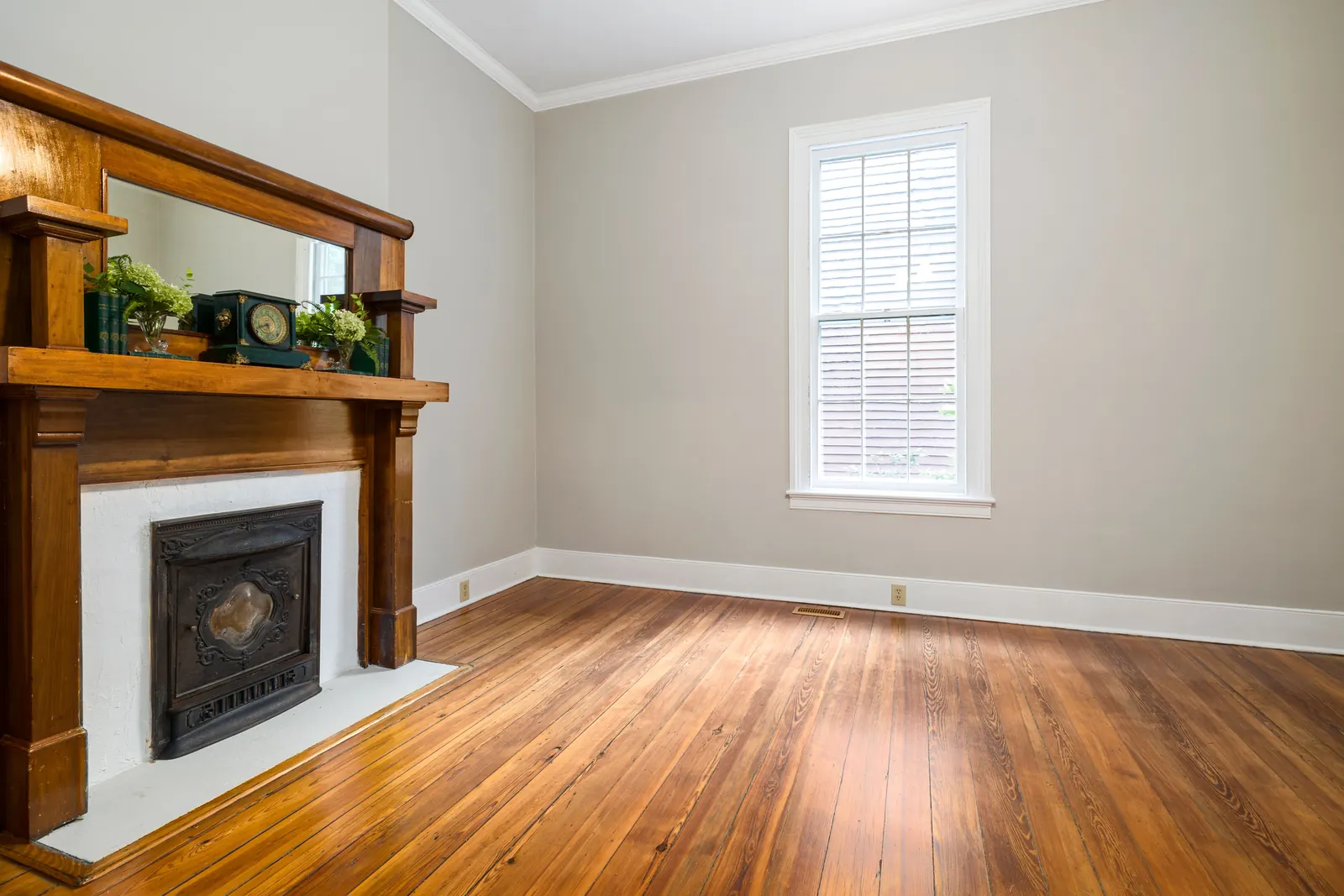
Why the distance matters
Heat leaves a fireplace opening in two ways. Hot gases roll out along the top of the opening and climb the face of the wall, and radiant heat travels straight out from the flames and glowing coals. A wood mantel sits directly in the path of that rising plume, and the more it projects into the room, the more hot air it catches underneath.
Wood that is heated again and again does not need to reach a flame to be damaged. It dries out, darkens and slowly chars, and charred wood catches fire more easily than sound wood. That process happens on the underside and back of the mantel, where nobody looks, so a mantel can appear perfectly fine for years while the hidden side is turning brown. Clearance rules exist to stop that slow damage before it becomes a fire.
Who sets the number
There is no single distance that fits every fireplace, which is why online charts cause so much confusion. For a factory-built fireplace, a gas fireplace or any insert, the unit was tested with specific clearances, and those appear in the manufacturer's installation instructions, usually as a diagram showing allowed mantel heights for each depth plus limits for side trim. If the manual is lost, the model number on the rating plate is what you need to get a copy.
For a site-built brick or stone fireplace, the clearance comes from the residential building code adopted where you live. New York City, New York State, New Jersey, Pennsylvania and Delaware each adopt and amend codes on their own schedules, and editions change, so the figure that applied when your house was built may not be the one enforced now. The local building department is the authority on which code and which figure apply to your work, and we encourage owners to ask there before building or replacing a mantel.
How the rule works on a masonry fireplace
Without quoting a figure, the logic of the masonry rule is consistent. Combustible material has to stay a minimum distance from the edges of the opening. Within a wider zone around the opening, combustible trim is allowed, but how far it may stick out is limited by how close it sits: the nearer to the opening, the flatter it has to be. The practical result for a homeowner is the trade-off people notice when shopping: a deep, chunky beam mantel has to go noticeably higher than a slim shelf.
Noncombustible materials change the picture. Stone, brick, cast concrete and tile set on a cement backer do not burn, so a surround made of them can come right up to the opening. That is why many fireplaces have a stone or tile face with the wood mantel mounted above and beyond it.
What counts as combustible
Homeowners are often surprised by what falls on the combustible side of the line. Paint and stain do not change the material underneath, and some products marketed as decorative stone are foam or resin. Clearance rules treat these as combustible:
- Solid wood and wood veneer mantels, painted or not
- Engineered wood such as MDF and plywood, including faux beams
- Wood paneling, wainscoting and decorative molding around the opening
- Gypsum board, because of its paper facing, unless a manual says otherwise
- Resin or foam pieces made to look like stone or timber
- Stockings, garland, candles and anything else hung or stood on the mantel
Original mantels in older houses
Brownstones, rowhouses and older colonials across the region often still have their original mantels. Many are marble or slate, which do not burn, but they are frequently backed by wood furring or set against a wood overmantel, and later owners sometimes added wood shelves or trim. Some of those details were installed long before current clearance rules existed.
Old does not automatically mean unsafe, and new work is not judged by what was there before. If you are reopening a fireplace that has been closed for years, adding a mantel, or converting to gas or an insert, measure the existing mantel and trim against the current requirement for that fireplace or appliance. When the numbers do not work, the usual options are raising the mantel, swapping a deep piece for a shallower one, or replacing nearby wood trim with a noncombustible surround.
Signs a mantel is too close
You can check a lot from inside the room. After an hour of a normal fire, rest your hand on the underside of the mantel. Warm is expected; too hot to keep your hand there is a warning. Then look for physical marks with a flashlight, ideally when the fireplace is cold:
- Brown or black darkening on the underside or front edge of the wood
- Paint that has blistered, yellowed or cracked just above the opening
- A smell of hot or toasted wood while a fire is burning
- Gaps opening at joints in the mantel or trim from repeated drying
- Candles or decorations on the shelf that soften, warp or drip
A TV above the fireplace
Heat rises, so a TV mounted over a working fireplace sits in the warmest air in the room. Check both manuals. The fireplace manual may address mantels and objects above the unit, and the TV's documentation lists the ambient temperature range it is designed for. A noncombustible mantel or a hood below the screen can deflect some of the plume, but it does not change the fact that the wall above is the hottest wall.
Gas fireplaces deserve particular attention here, because many run for hours at steady output and push hot air straight up the face. The same hand test works: after a long burn, touch the wall where the screen would hang. If you would not hold a phone there, a TV is not a good fit.
What a technician checks
During a fireplace inspection, the mantel and trim are measured against the manual for factory-built units, or against the opening for masonry ones. The technician looks for scorching, for wood framing that has been built too close behind the fireplace face, and for heat marks on the ceiling of the room or on the wall above a gas unit. You get a plain statement of what is fine and what should change, and any carpentry or masonry work comes as a free written estimate before anything is touched.
Common Questions
Where can I find a mantel clearance chart for my fireplace?
Do gas fireplaces need mantel clearance?
Does a stone or marble mantel need clearance?
Can a mantel heat shield let me keep my mantel lower?
Can you use a fireplace with a TV mounted above it?
Need help with this? See our fireplace repair service, or call (844) 468-2410 for a free written estimate.

