
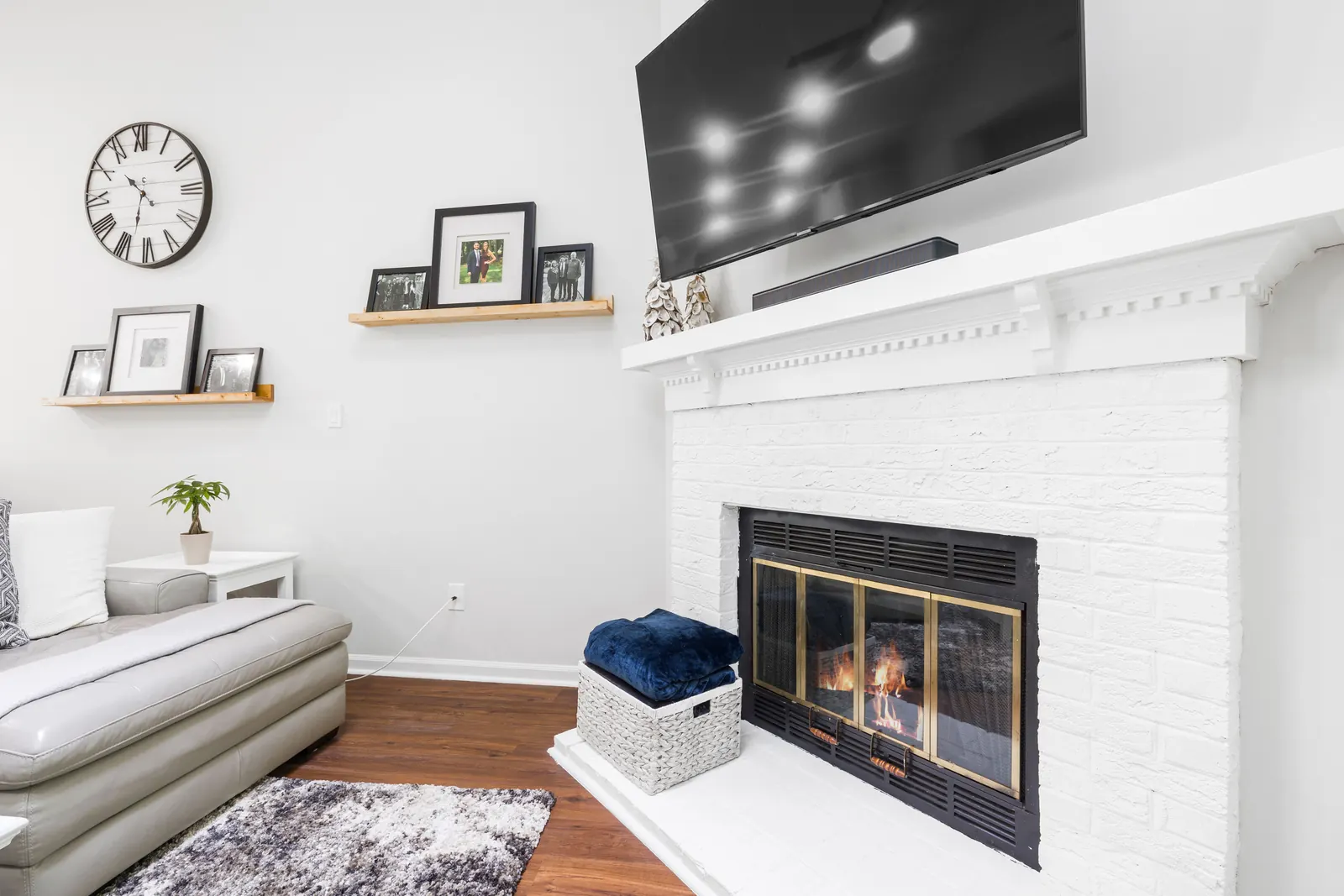
What refractory panels do
In a prefab or zero-clearance fireplace, the back and side walls of the firebox are large molded panels of refractory material, often cast with lines that imitate brick. They take the direct heat of the fire and hold it away from the steel firebox behind them.
That steel box, with air spaces and insulation around it, is what allows a factory-built fireplace to sit close to wood framing. The whole assembly was tested as a system. When a panel fails and flame reaches the metal, the shell can overheat, warp or eventually burn through, and the clearances the unit was designed around stop doing their job.
Is your fireplace prefab or masonry?
Many owners do not know which kind they have, especially in newer additions and in condos and townhouses built in recent decades. A few clues settle it. A factory-built unit usually has a metal top and sides inside the opening, louvers or a grille above or below the firebox, and a metal rating plate with a model number. The firebox walls are a few large slabs with even, molded joint lines rather than individual bricks. Outside, the chimney is often a framed chase with siding and a metal top, rather than solid brick.
A masonry fireplace has individual firebricks set in mortar, a cast iron or steel damper in a brick throat, and a brick or stone chimney. Cracked firebrick and failing joints in that kind of firebox are repaired with firebrick and refractory mortar, and the panel advice below does not apply.
Normal cracking versus real damage
Panels expand and contract every time the fireplace heats and cools, so fine cracks are expected. Many manufacturers state in the owner's manual how wide a crack may be before the panel has to be replaced. Check your model's limits, and use this as a practical guide when looking with a flashlight on a cold firebox:
| What you see | What it usually means | What to do |
|---|---|---|
| Thin hairline cracks, panel flat and solid | Normal heat cycling | Keep using it and watch at each sweep |
| Cracks getting longer or wider over a season | Panel weakening under stress | Compare with the manual's limits and book an inspection |
| Cracks you can see light or darkness through | Panel no longer a full barrier | Stop burning until it is replaced |
| Missing chunks, soft or sandy surface | Breakdown from age, overfiring or water | Replace and look for a water source |
| Panel shifted, bowed or loose in its slot | Retainers or the firebox may be damaged | Stop burning and have it inspected |
| Bare metal, rust or holes behind a panel | Shell exposed to direct fire | Do not use; panels and shell need evaluation |
Why panels wear out early
Panels are durable, but some habits shorten their life considerably:
- Loading the firebox beyond what the manual allows, or burning with the glass doors closed when the manual says open
- Throwing or dropping logs against the back panel
- Burning pallets, scrap lumber, cardboard or trash that flare very hot
- Using a grate the manufacturer did not approve, which can sit the fire too close to the back
- Hitting panels with fireplace tools while raking coals or removing ash
- Running a fire hard right after a long wet spell without letting the unit dry
Checking panels between sweeps
A quick look at the start of the season and again midwinter catches most problems while they are small. Wait until the firebox is cold, scoop out the ash so the lower edges are visible, and shine a flashlight along each panel from the side. Note where any crack starts and how far it runs, measured against a molded joint line or the panel edge, so you can tell later whether it has grown.
Leave the panels in place. Lifting them out to look behind risks chipping the edges and disturbing retainers, and it is easy to reinstall them in the wrong order. If something looks wrong, stop and let the technician remove them as part of the visit.
Water, rust and the chase top
On factory-built fireplaces with a framed chase, the top of the chase is closed with a metal cover. Over the years that cover can rust, dish in the middle and hold water, or lose the seal around the flue pipe. Rain then runs down inside, into the firebox. Wet refractory material that is heated cracks, flakes and crumbles faster, and rust streaks appear on the metal around the panels.
Our region makes this worse. Nor'easters drive rain sideways into any gap, and freeze-thaw cycles work water into cracks all winter. If the panels are failing and you also see rust, water stains on the hearth, or a musty smell from the opening, the leak has to be fixed along with the panels, or the new set will go the same way.
Replacing panels the right way
Because the fireplace was tested as a complete system, replacement panels should be the ones the manufacturer lists for that exact model. A panel cut for a different unit may leave gaps, sit at the wrong angle or be made from a material with different heat behavior. The model and serial number on the rating plate, often found inside the opening, behind the lower grille or on the smoke shelf area, are used to order the correct set.
The job itself is usually straightforward. The grate and any loose debris come out, the old panels are removed in the order the manual describes, and the new ones are set so they fit snugly into their retainers. While the panels are out, the technician looks at the bare steel firebox, the damper, the flue connection and the chase interior, which is the one moment those parts are fully visible.
When the whole fireplace should be replaced
Sometimes new panels are not the answer. If the steel firebox is warped, rusted through or burned, if the manufacturer no longer supplies parts for the model, or if the unit has had several sets of panels fail early, replacing the fireplace may make more sense than another repair. A factory-built firebox cannot be patched with masonry or welded steel and still keep its listing.
Options at that point include a new factory-built fireplace sized for the framing, or a gas or electric unit approved for the space. Any insert or log set going into an existing prefab firebox has to be specifically allowed by that fireplace's manufacturer. An inspection lays out what the shell's condition supports, and our own crew handles the panels, the chase and the flue in one visit.
Common Questions
Are cracked fireplace refractory panels dangerous?
Can you repair a cracked refractory panel?
Why is the brick in my prefab fireplace cracked?
Can I use firebrick to replace refractory panels?
How long do fireplace refractory panels last?
Need help with this? See our fireplace repair service, or call (844) 468-2410 for a free written estimate.

