
What seasoning actually does
A freshly cut tree holds a great deal of water, a large share of the log's weight. Seasoning is simply letting that water leave. It moves out through the cut ends and split faces far faster than through bark, which is why split wood dries much quicker than whole rounds. As the moisture drops, the wood gets lighter, shrinks slightly and cracks.
Burning wood before it has dried means the fire spends its first energy boiling water. The flames run cooler, the smoke is heavier, and much of that smoke condenses in the chimney as creosote.
No single sign is proof, but together they give a reliable picture.
| Check | Seasoned | Wet or green |
|---|---|---|
| Weight | Light for its size | Heavy and dense |
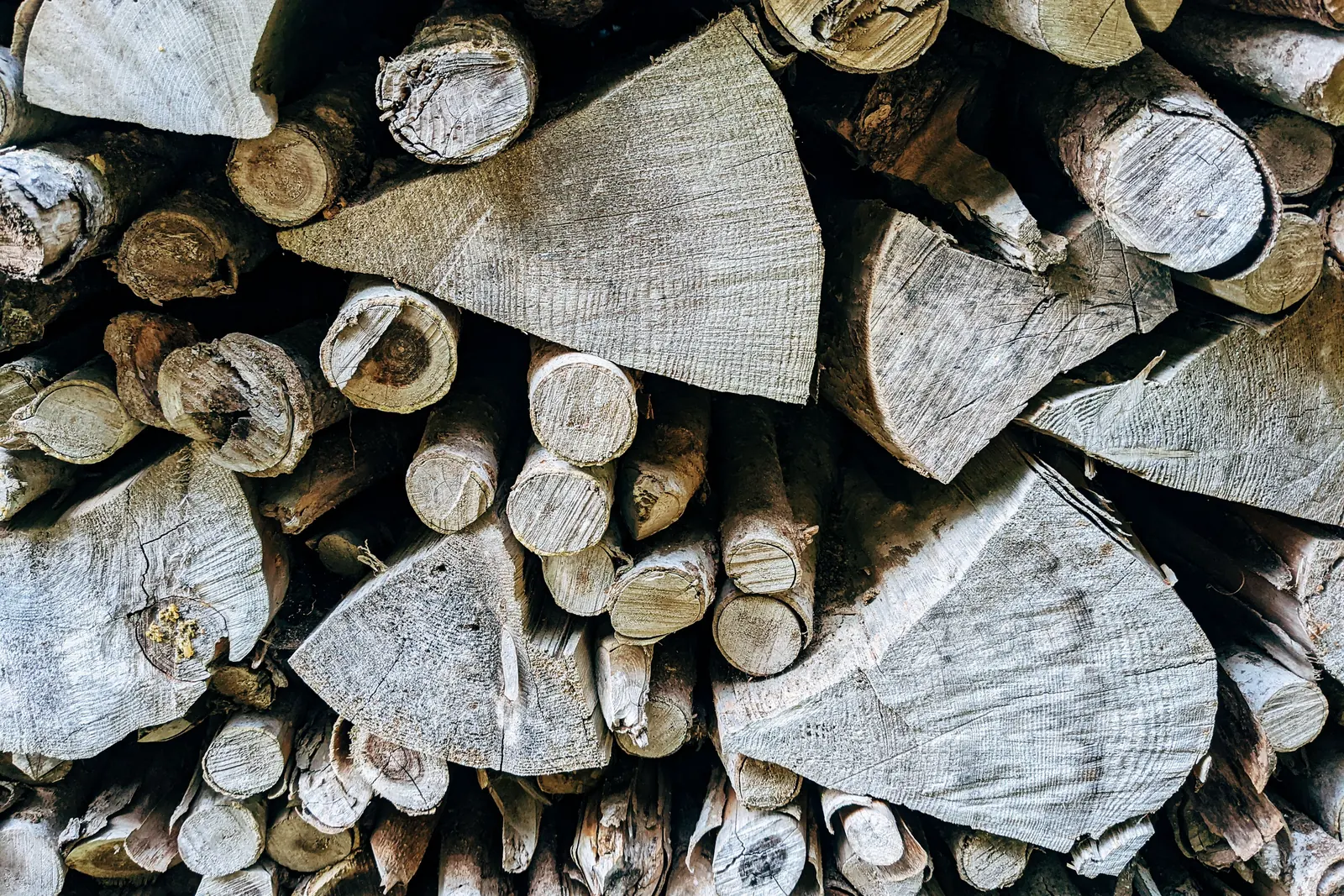
| Ends | Gray or tan, with cracks running from the center | Bright, even color, few or no cracks |
| Bark | Loose, peeling or falling off | Tight to the wood |
| Sound when knocked together | Sharp, hollow clack | Dull thud |
| Fresh split face | Dry and warm to the touch | Cool, damp, smells of sap |
| In the fire | Catches fast, bright flames | Hisses, steams, smokes, bubbles at the ends |
Quick tests without tools
Pick up two pieces of about the same size and compare. Dry wood feels surprisingly light. Knock them together near your ear: seasoned wood rings with a sharp, hollow note, wet wood gives a flat thud. Look at the ends for checks, the cracks that radiate from the center as the wood shrinks.
Then split one piece and touch the fresh inner face. If it feels cool and damp, or smells strongly of sap or sourness, it is not ready, however weathered the outside looks. The fire gives a last check: seasoned wood catches quickly and burns with bright flames, while wet wood hisses, steams and pushes water or foam out of its ends.
Using a firewood moisture meter
An inexpensive pin-type moisture meter takes the guessing out. The trick is measuring in the right place. The outside of a log dries first and reads drier than the core, so a reading taken on the bark side flatters the wood.
- Pick a piece from the middle of the stack, not the top
- Split it, and push the pins into the fresh face across the grain
- Take readings on a few pieces, not just one
- Treat around 20 percent or lower as ready to burn
- Restack and wait if readings come in well above that
How long it takes to season
The U.S. EPA's firewood storage guidance recommends seasoning softwoods for at least six months and hardwoods for at least twelve. Species matters within that: dense hardwoods like oak are slow and often need more than one summer, while lighter woods like maple, ash or birch dry faster. Wood split smaller dries faster than large splits.
Climate matters too. A humid coastal summer and a short drying season, typical of the mid-Atlantic coast, stretch those times. Wood cut in late fall and stacked over winter does little drying until the warm months arrive.
Species and how they season
Firewood sold around the Northeast is mostly mixed hardwood: oak, maple, ash, cherry, birch and hickory, with some locust. Dense woods like oak and hickory hold heat longest once dry but are the slowest to season, and oak in particular can stay wet at the core long after its ends look gray. Maple, cherry and birch dry more readily. Ash is known for drying relatively fast.
Softwoods like pine dry quickly and light easily, which makes them good kindling. Dry pine is fine to burn; the creosote reputation comes from burning it wet.
Storing it so it actually dries
The same EPA guidance sets out the basics: split wood before stacking, keep it off the ground on a base, and cover the top with a roof that overhangs enough to keep off rain and snow, sloped so water runs off. Leave the sides open so wind can move through the stack. A pile under a tarp wrapped to the ground traps moisture and grows mold instead of drying.
Keep the main stack away from the walls of the house, which keeps insects out of the siding and fuel away from the building. Bring in only a day or two's supply at a time.
A few stacking habits speed things up. Stack in single rows rather than one deep pile, with the split faces exposed to the air. Leave a hand's width between rows and between the stack and any fence. Put the newest wood at the back or on a separate stack, so you burn the oldest, driest wood first and the fresh supply gets its full drying time.
Wood to keep out of the fireplace
Dryness is one test; what the wood is matters too. The EPA's wood-burning guidance lists materials that release harmful chemicals when burned and can damage the appliance.
- Coated, painted or pressure-treated wood
- Plywood, particle board or any wood with glue in it
- Ocean driftwood
- Wet, rotted, diseased or moldy wood
- Household trash, cardboard, plastics and glossy printed paper
Is firewood sold as seasoned really dry?
Not necessarily. The word is used loosely, and wood labeled seasoned can mean anything from properly dried to cut a few months ago. Check a few pieces when a delivery arrives: weigh them in your hand, look at the ends and test a fresh split with a meter. If the readings are high, stack it properly and burn it next year, not this one.
Kiln-dried wood is dried in a heated chamber and usually reads low on a meter, though it can pick up moisture again if left uncovered. Bundles sold in stores are often kiln-dried and are a handy backup, but a winter's supply is usually better bought by the cord, early, and dried at home.
Why it matters to the chimney
Wet wood is one of the most common reasons a flue shows heavy creosote after a single winter. Its cool, smoky burn coats the flue faster than anything else a homeowner controls, and that coating narrows the flue, slows the draft and becomes fuel for a chimney fire. Dry wood burns hotter and cleaner, and the inspection is far more likely to find a light dusting.
Burning dry wood does not replace the yearly chimney inspection that NFPA 211 calls for, but it is the habit that does the most to keep the sweep's job easy.
Common Questions
How can I tell if firewood is seasoned enough?
Is firewood sold as seasoned really dry?
Can firewood be too dry?
How long does firewood take to season?
Can I dry firewood indoors?
Need help with this? See our chimney sweeping service, or call (844) 468-2410 for a free written estimate.

