
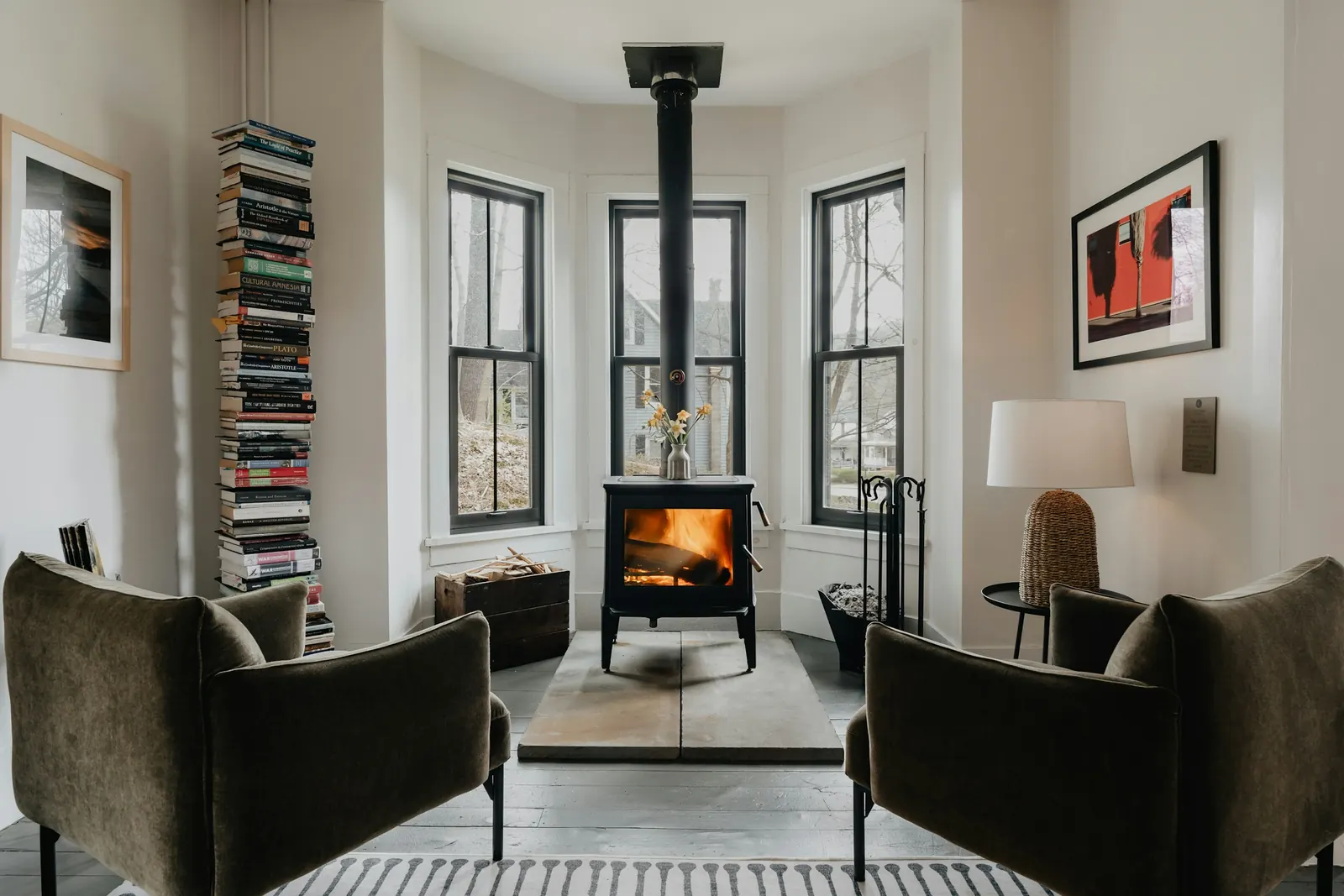
Connector pipe versus chimney pipe
The pipe between a wood stove and its chimney is called the connector, or stovepipe. It is exposed, in the room, and easy to inspect and take apart for cleaning. The chimney is the vertical passage that carries smoke the rest of the way, either a masonry chimney with a liner or a factory-built insulated metal chimney. These are different products tested for different jobs, and mixing them up is a common and serious installation mistake.
Stove pipe, whether single or double wall, is not made to pass through ceilings, attics, floors or walls built of wood framing. Where the vent leaves the room, the system changes to listed factory-built chimney pipe through a ceiling support or a wall pass-through, or it enters a masonry chimney through a thimble.
Single wall pipe
Single wall stovepipe is one layer of painted steel, usually black. It is inexpensive, easy to cut and fit, and radiates a lot of heat into the room, which some owners like. That same radiant heat is why it needs generous clearance to walls, ceilings, furniture and trim. New York City's Mechanical Code lists 18 inches of clearance to combustibles for connectors serving domestic solid fuel-burning appliances, unless the appliance's listing specifies a different clearance.
Because the pipe sheds heat so readily, the smoke inside cools faster. On a long run, a cold room, or a stove that is run low, that cooling means more creosote in the pipe and the chimney and a weaker draft.
Double wall pipe
Double wall stovepipe has an inner pipe that carries the smoke and an outer shell with an air gap between. The outer surface runs much cooler than single wall pipe, so a listed double wall connector is tested for reduced clearance to combustibles, and its label and instructions give the exact distance. That makes it the usual choice when a stove has to sit close to a wall or a low ceiling.
The inner pipe stays hotter, which keeps the smoke warm and moving. That supports a stronger draft and less condensation of creosote, a real benefit with modern stoves whose flue gases already run cooler than old stoves. Most double wall pipe also comes with a telescoping section that makes installation and later removal for sweeping easier.
Side by side
The choice usually comes down to clearance and draft. Price matters less over the life of a stove than either.
| Factor | Single wall | Listed double wall |
|---|---|---|
| Clearance to combustibles | Large; 18 inches under NYC code unless a listing differs | Reduced, to the distance on its listing |
| Heat into the room | High radiant heat from the pipe | Lower; more heat goes up with the smoke |
| Draft and creosote | Smoke cools faster; more deposits on long runs | Hotter flue gas; better draft, fewer deposits |
| Fitting and cleaning | Easy to cut and fit | Slip or telescoping sections; easy to remove |
| Where it suits | Short, open runs with plenty of room | Tight spaces, low ceilings, long runs, newer stoves |
Rules that apply to both
Codes and stove manuals are specific about connectors, and the details matter for safety and for insurance. Reading New York City's code as an example, connectors must stay entirely within the room where the appliance sits, may not pass through any floor or ceiling, and may cross a combustible wall only with a listed pass-through system or one of the specific methods the code tabulates. Your town may enforce a different code edition, so confirm locally; the stove's own manual adds its own limits on top.
Good practice and code text line up on the basics: joints fastened with sheet metal screws or rivets, the pipe the same size as the stove's flue collar, a steady rise toward the chimney, and an entry into a masonry chimney well above the base of the flue so debris does not block it.
- Pipe diameter not smaller than the stove's flue collar
- Crimped ends pointing down toward the stove so condensate runs back inside
- Each joint fastened with screws, rivets or the maker's locking system
- A rise toward the chimney rather than a level or sagging run
- As few elbows and as short a horizontal run as the layout allows
Mixing single and double wall
Adapters exist to join single wall pipe to double wall pipe or to factory-built chimney pipe, and they are a normal part of many installations, for example where the connector meets a ceiling support box. What does not work is assuming the clearance of the better pipe for the whole run. Each section keeps the clearance its own type requires, so a single wall section near a wall needs single wall clearance even if the rest is double wall.
Mixing brands is another trap. Double wall pipes and chimney pipes lock together with maker-specific joints, and parts from different systems may fit loosely or not at all. Use the adapter the pipe maker lists.
Where older homes complicate it
Many stoves in the region connect to old masonry chimneys through a thimble in the chimney breast, often a clay sleeve set when the house had a coal stove or kitchen range. Those thimbles may be cracked, loose, or too close to wood framing inside the wall, and some sit at a height that forces a long, sagging horizontal run. Before choosing pipe, have the thimble and the flue behind it inspected. An unlined or oversized flue will draft poorly no matter what connector feeds it.
Basement stoves often face low ceilings with joists overhead, which is exactly where single wall clearance becomes hard to meet. Double wall pipe or a different stove position is usually the answer.
Inspecting what you have
Look at the pipe with the stove cold. Rust-through, pinholes, joints that have separated, screws missing, a sag in the middle of the run, and white or orange streaks at the seams are all reasons for replacement. Measure from the pipe to the nearest wall, ceiling and trim, and compare with the clearance for that pipe type. A connector that glowed red at some point, or has blistered paint, may have been through a chimney fire and the chimney should be checked as well.
The connector is swept along with the chimney. If it is hard to take down because it was installed as one rigid piece, that is worth fixing too.
Common Questions
Do I need double wall stove pipe?
Can stove pipe go through a ceiling?
Which way do the crimped ends of stove pipe go?
Can I use single wall and double wall pipe together?
How long can a stove pipe run be?
Need help with this? See our wood stove installation service, or call (844) 468-2410 for a free written estimate.

