
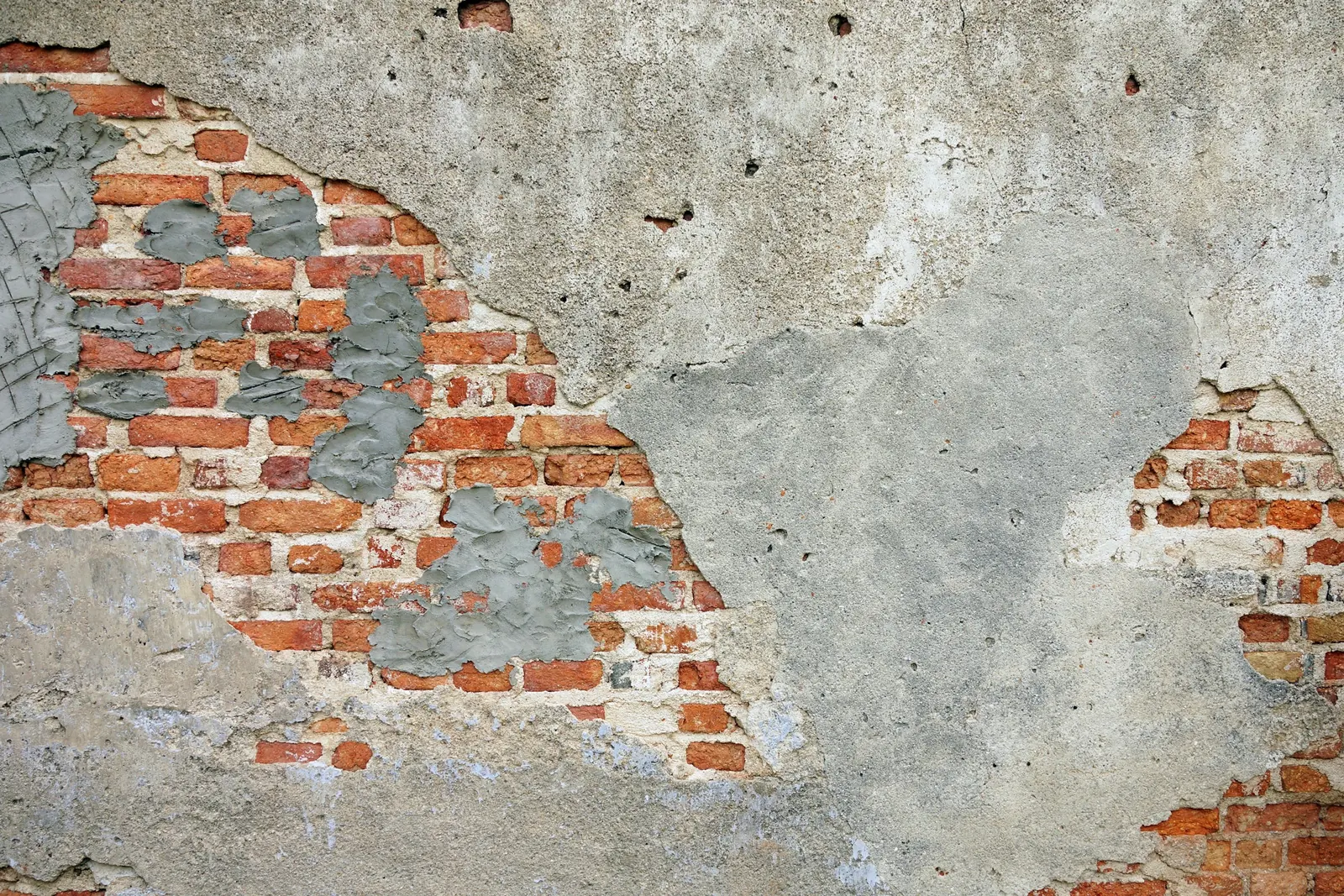
What spalling looks like
You may first notice chips of brick on the roof, in the gutter or on the ground below the chimney. Up close, spalled brick has a rough, broken face where the smooth, fired outer skin used to be. Some bricks look as if they were scooped out in the middle; others shed thin layers like pastry; others have a clean slab of face lying beside them on the roof.
It usually shows up first on the side of the chimney that takes the most weather, often the north or west face in this region, and on the top few courses just under the crown, where rain arrives from every direction and snow sits longest. Spalling often travels with white efflorescence, a sign that water is moving through the masonry and leaving salts on the surface as it dries.
How freeze-thaw breaks a brick
Brick is porous. Rain soaks into the outer layer, and on a cold night the water freezes. Ice takes up more room than water, so it presses outward on the pores near the surface. One freeze does little. A winter in New York, New Jersey or around Philadelphia brings many cycles of freezing at night and thawing by day, and each cycle pushes the face a little further from the body of the brick until it lets go.
Salts make it worse. As water evaporates from the brick, dissolved salts crystallize just under the surface and grow, adding their own pressure. That is why spalling and white staining so often appear on the same bricks.
Why chimneys spall more than walls
A chimney stands out in the open above the roof with no eaves to shelter it. It gets wet on four sides and the top, then cools fast on winter nights because cold air reaches every face. A house wall below the roofline dries more slowly but also freezes less hard. The exposed stack takes the worst of both.
A chimney serving a boiler or water heater has a second source of moisture. Warm flue gas carries water vapor, and in an unlined or poorly lined chimney that vapor can condense inside the masonry and soak the brick from within. When the outer face also takes rain, the brick is wet from both sides and spalls fastest of all.
- Rain soaking in through a cracked crown or open joints
- No cap, so water runs down the inside of the flue
- Repointing with mortar harder than the brick
- Paint or a non-breathable sealer that traps water in the brick
- Condensation from boiler or water heater gases in an unlined flue
- Soft, underfired brick that absorbs more water than its neighbors
Why the mortar choice matters
Water that gets into masonry has to leave somewhere. In a well-built chimney, much of it leaves through the mortar joints, which are meant to be softer and more porous than the brick. When someone repoints old, soft brick with a hard, dense cement mortar, the joints stop breathing and the water exits through the brick face instead. That is where the face fails, and the hard joint also refuses to flex as the brick moves, cracking the brick edges beside it.
This is why we see chimneys where the mortar looks perfect and the bricks around it are falling apart. Matching the mortar to the brick, often a lime-rich mix on older houses, is part of a lasting repair.
How bad is it? Reading the damage
Not every flaked brick needs the same response. The amount and location of the damage, and whether bricks are loose, decide what happens next.
- Light surface flaking on a few bricks is early water damage: fix the water source and keep watching
- Bricks that have lost their face now absorb more water and should be cut out and replaced
- Many spalled bricks in the top courses mean the top section is breaking down and should be rebuilt above the roofline
- Loose bricks or a leaning top signal structural weakening: repair urgently and keep the area below clear
How spalled brick is repaired
Badly spalled bricks are cut out and replaced with brick that matches in size, color and hardness, then the joints around them are repointed with a compatible mortar. Turning a damaged brick around to show its back face is sometimes done on old work, but only where the brick is otherwise sound. If many bricks near the top are gone, rebuilding that top section from the roofline up often makes more sense than replacing them one at a time.
The repair only holds if the water source is fixed too. That can mean a new crown that overhangs the brick with a drip edge, a cap on every flue, flashing work at the roof, or a liner for a boiler flue. A breathable water repellent may help once the masonry is sound and dry, but a coating that seals water in makes spalling worse.
What a technician checks
An inspection for spalling looks at more than the damaged bricks. The technician checks the crown for cracks and overhang, the cap, the flashing, the mortar type and condition, and whether the brick has been painted or coated. Inside, the flue is checked for condensation damage, and in the attic or on the chimney breast for signs of water. The goal is to find every way water is getting into the masonry, so the replaced bricks do not spall again.
Timing matters as well. Masonry repairs need mortar to cure above freezing, so replacing spalled brick is usually planned for spring through fall. If damage is found in midwinter, the urgent part, such as securing loose bricks or covering an open flue, can be done right away and the full repair scheduled for milder weather. You should get a written description of what will be replaced, how the brick will be matched and which water sources will be fixed.
What you can see from the ground
With binoculars, look for bricks with rough, broken faces, chips collecting on the roof or in the gutter, white powder on the brick and a crown that looks cracked or thin. Look at the chimney after rain: dark, wet patches that stay long after the rest of the brick has dried show where water is sitting. If pieces are falling, keep people clear of the area below and arrange a repair before the next storm. Leave the climbing to a crew with the right gear.
Common Questions
What does spalling brick mean?
Can spalling brick be repaired without replacing it?
What decides the cost of a spalling chimney repair?
Will sealing the chimney stop spalling?
Is spalling covered by homeowners insurance?
Need help with this? See our masonry & tuckpointing service, or call (844) 468-2410 for a free written estimate.

