
Where the numbers come from
A wood stove sold today is tested by a lab to a safety standard, and the test sets how close the stove can sit to combustible walls and what it needs underneath. The results go on a metal label, usually on the back of the stove, and into the installation manual. Codes point back to that label. New York City's Mechanical Code, for instance, requires fireplace stoves and solid fuel room heaters to be listed and labeled and installed according to their listing, and hearth extensions for them to follow that listing too.
That is why a figure quoted online or from a neighbor's install means little for your stove. Two stoves of similar size can have very different clearances depending on their heat shields, firebox design and whether a rear shield or blower is fitted.
What the label covers
A typical label and manual give separate numbers for each direction, with drawings, and often two sets: one with the stove's optional heat shields fitted and one without.
- Rear clearance to the wall behind the stove
- Side clearance to walls left and right
- Corner clearance, measured diagonally, for a stove set at an angle
- Clearance from the stovepipe to the wall and ceiling
- Floor protection type, and how far it must extend in front, to the sides and behind
- Whether the stove is approved for alcove or mobile home use, and the limits that apply
What counts as combustible
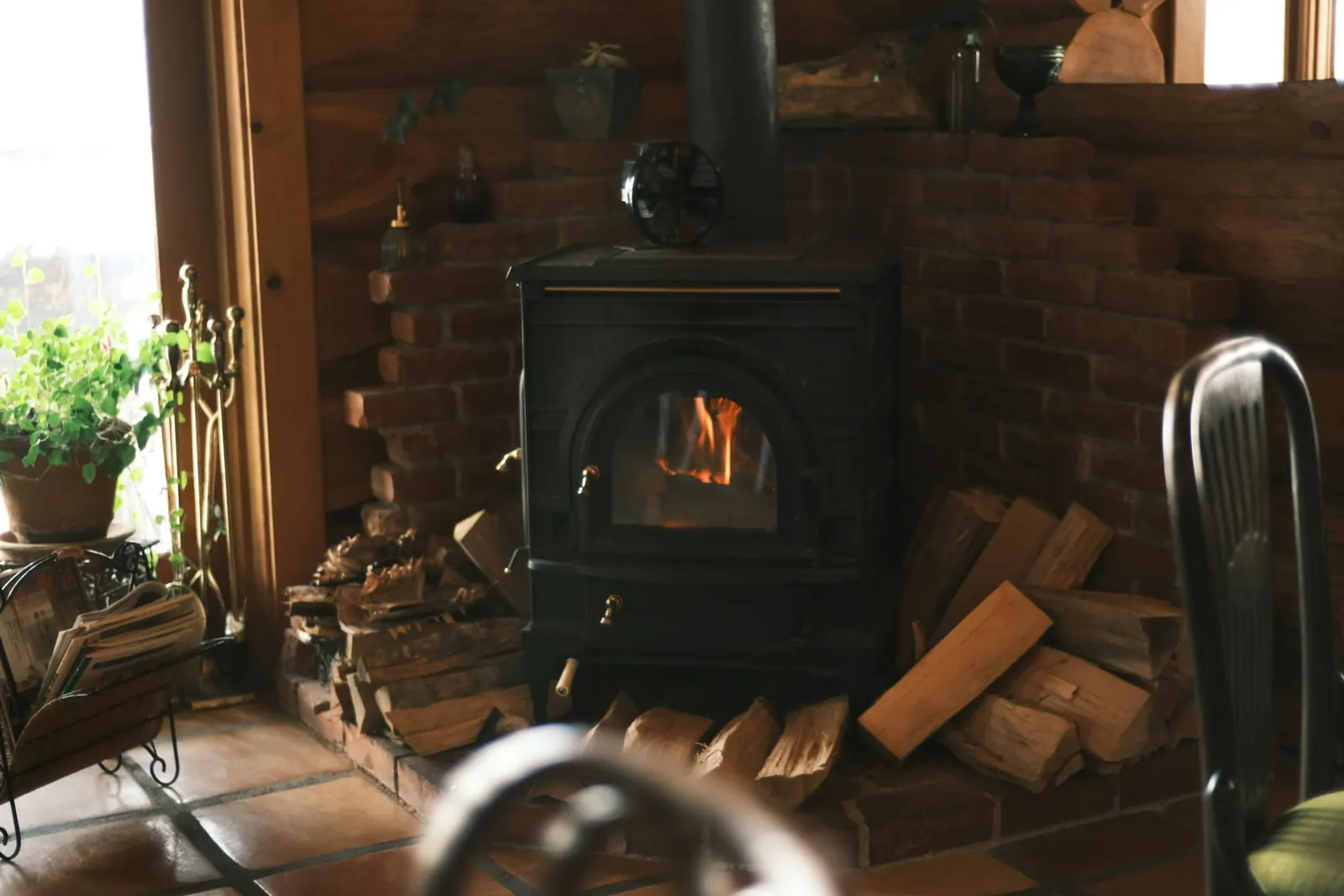
The definition is the whole wall, not its surface. Drywall on wood studs is combustible. So is tile, stone veneer or thin brick applied over a framed wall, because heat passes through the facing to the studs behind and slowly chars them. A wall counts as noncombustible only when its entire construction is, such as a solid masonry wall with no framing in it.
Older rowhouses and brownstones often have real masonry party walls, which can change the picture for a stove placed against them. Even then, wood furring strips, paneling or trim fastened to the brick are combustible. When in doubt, treat the wall as combustible and use the label's clearance.
Wall shields and reduced clearance
Clearances can be reduced with a heat shield, but only by a method that has been tested or that the code or the stove manual describes. The common approach is a noncombustible panel, such as sheet metal or masonry board, held off the wall on noncombustible spacers so air can move behind it, open at the bottom and top. That air gap carries heat away; a panel fastened flat against the wall does very little.
Listed wall shields and stove boards come with their own instructions and reduction allowances. Whatever is used, the reduced distance is measured from the stove to the shield's protected wall exactly as the method allows. A home-built shield that does not match a recognized method is a guess.
Floor protection and the hearth pad
Under and in front of the stove, the floor needs protection for two reasons: hot coals falling out of the door, and heat radiating down through the stove's base. The label says which protection is needed. Some stoves need only ember protection, a continuous noncombustible surface. Others with less shielding underneath need thermal protection, a pad with a stated insulating value, which matters on wood floors.
The label also sets how far the pad must extend in front of the door and beyond the sides. Code language adds that the hearth extension should be readily distinguishable from the surrounding floor, so nobody sets a rug or a basket on it without noticing. Grout lines and joints in a tile pad must be solid, so embers cannot drop through to the wood below.
The stovepipe has its own clearance
Stovepipe gets hot, and its clearance often controls where the stove can go more than the stove itself does. Single wall pipe needs the most room: New York City's code sets 18 inches from connectors of domestic solid fuel appliances to combustibles, unless the appliance's listing specifies something else. Listed double wall pipe is tested for much less, as its label states.
Connectors also must stay in the room and may not pass through floors or ceilings, or through combustible walls without a listed pass-through. Plan the stove position and the pipe route together, since a stove that clears its side wall can still have its pipe too close to a ceiling joist or a window casing.
| Item | Where the requirement comes from | Frequent mistake |
|---|---|---|
| Stove to walls and corners | Listing label and manual | Using a general rule instead of the label |
| Floor protection | Listing label: type and extension | Rug or wood trim at the edge of the pad |
| Stovepipe to walls and ceiling | Pipe type listing; code tables for single wall | Single wall pipe near a joist or window trim |
| Wall shield reductions | Listed shield instructions or code methods | Panel fixed flat with no air gap |
| Furniture, wood, curtains | General fire safety guidance | Firewood stacked beside the stove |
Old and unlabeled stoves
Many older stoves, especially those bought secondhand or found in an old house, have no label or one that is unreadable. An unlisted stove cannot use reduced clearances, because nobody tested it. Fire codes give large default clearances for unlisted solid fuel appliances, far beyond what a modern labeled stove usually needs, and some places do not allow unlisted stoves at all. In New York City, the Mechanical Code requires these stoves to be listed and labeled.
Insurers often ask about the stove when a policy is written or renewed, and an unlisted stove or one installed too close to a wall can cause trouble with coverage after a loss. If the stove has no label, it is usually worth replacing rather than trying to fit it safely.
Living around the stove
Clearances on the label protect the building. Day-to-day use adds everything that moves: chairs, a sofa pulled closer in January, drying laundry, kindling boxes and the firewood stack. The U.S. Fire Administration's guidance is to keep anything that can burn at least three feet from heat sources, including wood stoves. A small stack of wood for the evening can sit beyond that distance and be refilled as needed.
Children and pets need their own planning: a freestanding hearth gate keeps hands off hot steel. And because every wood stove can spill smoke, keep carbon monoxide and smoke alarms working on every level of the home.
Common Questions
How far does a wood stove need to be from the wall?
Is a brick wall behind a wood stove enough?
Does a wood stove on a concrete floor need a hearth pad?
How big does a wood stove hearth pad need to be?
Need help with this? See our wood stove installation service, or call (844) 468-2410 for a free written estimate.

